Most hobby advice falls into one of two unsatisfying categories. Either it is so basic it tells you things you already know, or it is so advanced it assumes expertise you haven’t yet developed. Finding guidance that meets you exactly where you are — specific to your current skill level, your particular equipment, your actual garden conditions, or the specific dish you are trying to master — has historically meant paying for private lessons, joining a club and hoping someone knowledgeable shows up, or spending hours trawling through forums where the signal-to-noise ratio is brutal before you are able to learn about AI tools for hobbyists or for your particular hobby.
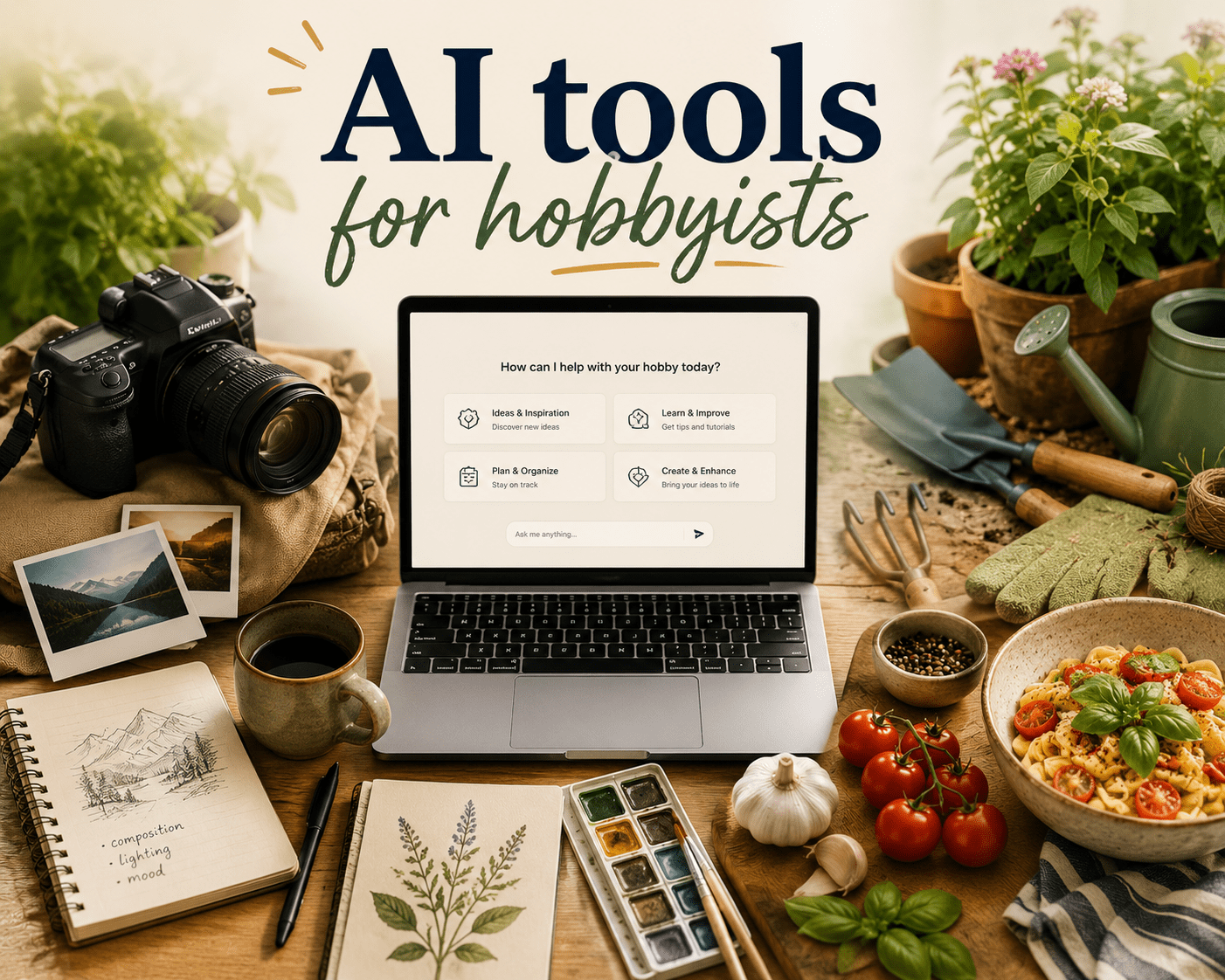
AI tools for hobbyists have changed this entirely. The combination of personalised, on-demand guidance, infinite patience for follow-up questions, and the ability to adapt advice to your exact situation makes AI one of the most genuinely useful developments for anyone pursuing a hobby seriously. This guide covers how AI is being used across photography, cooking, gardening, and creative hobbies — with specific, practical guidance for each.
Why Hobby Learning Has Always Been Frustratingly Generic
Before getting into the specific applications, it is worth being clear about the problem AI tools for hobbyists actually solve — because the solution only makes sense when the problem is precise.
Generic hobby advice fails because hobbies are inherently personal. A photography tutorial that tells you to “use the rule of thirds” is technically correct but useless if your specific problem is that your indoor portraits are coming out with a yellow colour cast that no amount of rule-of-thirds application will fix. A gardening guide that tells you to “plant tomatoes in a sunny spot” is useless if your garden gets afternoon shade, your soil is clay-heavy, and you live somewhere with cool summers.
The value of AI tools for hobbyists is not that they know more than the best human experts — they don’t. The value is that they know enough to give you specific, contextualised guidance, and they are available at the exact moment you need them, for as long as you need them, with infinite patience for the follow-up questions that reveal your actual confusion rather than your politely phrased surface question.
AI Tools for Hobbyists: Photography
Photography is one of the hobbies where AI assistance delivers the most immediate, tangible improvement — particularly for people who understand the creative side of photography but struggle with the technical settings that determine whether the creative vision becomes a good photograph.
Diagnosing what went wrong.
The most frustrating experience in photography is taking a shot that should have worked and ending up with something disappointing — blurry, dark, washed out, or just not what you saw through the viewfinder. AI is exceptionally good at diagnosing why a photograph didn’t work when you describe the conditions and the result.
“I was photographing my daughter at her school play. The venue was a large hall with warm overhead stage lighting. I was shooting on my Canon R50 with the kit lens. The photos came out blurry and the colours look orange. My settings were automatic mode. What went wrong and what should I do differently next time?”
This description gives AI enough to provide a specific, actionable diagnosis — the automatic mode struggled with the low, warm light; you needed a higher ISO, a wider aperture, and either a custom white balance or a correction in post-processing — rather than a generic tutorial on camera settings that doesn’t address your specific situation.
Building a learning plan tailored to your camera and goals.
Rather than working through generic photography courses, use AI to build a learning plan specific to your equipment, your current level, and what you actually want to photograph.
“I have a Sony A6400, and I mostly photograph my children at home and outdoors. Even though I understand basic composition, my technical settings are still mostly automatic. I want to move to full manual control, so I understand what I’m doing. Please build me a four-week learning plan that takes me from automatic to confident manual shooting, with specific exercises I can do at home.”
The resulting plan is specific to your camera model, your subjects, and your goal — not a generic beginner photography curriculum that covers wildlife photography and studio lighting you have no interest in.
Post-processing guidance.
AI guides you through editing software step by step, answering the specific question you have about the specific tool you are using rather than requiring you to watch a forty-minute tutorial to find the two-minute answer you need. “I am using Lightroom Classic. I have a portrait where the skin tones look too warm and the background is slightly overexposed. Walk me through the specific adjustments I should make, in the order that makes most sense.”
What AI cannot do for photography.
AI cannot look at your photographs and tell you what is wrong with them — it works from your descriptions rather than the images themselves, unless you upload them to a tool with image understanding capability. For visual feedback on specific images, uploading to Claude or ChatGPT with image capability and asking for a critique produces more useful results than describing the image in text. Additionally, AI cannot replace the experience of shooting — it can tell you what settings to use, but developing the instinct to choose them in the moment requires practice.
AI Tools for Hobbyists: Cooking
Cooking is a hobby where AI tools have become genuinely transformative — not just for recipe lookup, which AI handles competently, but for the deeper problems that actually hold cooks back.
The “what can I make with what I have” problem.
The most common cooking frustration is standing in front of a reasonably stocked fridge and not knowing what to make. AI solves this with a specificity that recipe apps cannot match.
“I have chicken thighs, half a can of coconut milk, some wilting spinach, garlic, ginger, one onion, and a lemon. I don’t have any fresh chillies, but I have dried chilli flakes. What should I make that takes under 40 minutes and produces minimal washing up?”
The AI produces a recipe that uses exactly what you have, accounts for what you don’t have, fits your time constraint, and adapts to your washing-up preference. No recipe app does this reliably. No search engine does this without sending you to seventeen different websites.
Understanding why a dish went wrong.
When a recipe produces a disappointing result, most home cooks either blame themselves vaguely or blame the recipe and move on. Neither response improves future cooking. AI diagnoses what actually went wrong.
“I made a beef stew following a recipe and the meat came out tough rather than tender, even though I cooked it for two hours. The recipe said to use braising steak. What might have gone wrong and how do I prevent it next time?”
A specific question like this produces a specific answer — the temperature may have been too high, the collagen needs longer to break down at lower temperatures, or the cut of meat wasn’t quite right — along with practical guidance for next time.
Building cooking skills systematically.
Most home cooks develop their skills randomly, picking up techniques through individual recipes without understanding the underlying principles. AI can teach cooking skills as a system rather than a collection of unrelated recipes.
“I want to become a genuinely competent home cook rather than someone who just follows recipes. I can currently follow a recipe reliably but I don’t really understand why I’m doing each step. Please help me understand the ten most important fundamental cooking techniques and principles that would give me the most improvement in my everyday cooking.”
The resulting curriculum — understanding heat control, knowing when meat is cooked by feel rather than timer, understanding how emulsification works, knowing how to build flavour through seasoning at different stages — transfers across every recipe you cook rather than being tied to specific dishes.
Dietary adaptation.
Adapting recipes for dietary requirements — allergies, intolerances, specific dietary choices — is something AI handles better than any other resource. “Please adapt this pasta carbonara recipe for someone who is dairy-free and also doesn’t eat egg yolks. I want something that has a similar richness and creaminess to the original.” The AI produces a genuine adaptation rather than a disappointing approximation, explaining which ingredients are doing what in the original so the substitutions are informed rather than random.
AI Tools for Hobbyists: Gardening
Gardening presents specific challenges that make it one of the hobbies where AI tools for hobbyists add the most value — primarily because the right answer for any gardening question depends so heavily on local conditions that generic advice is almost useless.
Diagnosing plant problems.
When a plant looks wrong — yellowing leaves, spots, wilting, failure to flower, poor growth — diagnosing the cause from description is exactly what AI does well.
“My hydrangeas have leaves that are yellowing between the veins but the veins themselves are still green. The soil in this area of the garden tends to be quite alkaline. The plants are in a partially shaded bed. What is likely causing this and what should I do about it?”
This description — yellowing between veins with green veins remaining, alkaline soil — is a classic presentation of iron chlorosis caused by high soil pH preventing iron absorption. AI identifies this, explains why it happens, and gives specific corrective options — acidifying the soil, applying chelated iron, or moving to containers with ericaceous compost — that are specific to the described conditions.
Planning a garden around your specific conditions.
The most common gardening mistake is buying plants that are wrong for the conditions rather than choosing plants that suit what you actually have. AI helps you plan around reality rather than aspiration.
“My back garden faces north, gets about three hours of direct sun in summer, has heavy clay soil, and is in climate zone 8. I want low-maintenance planting that looks good from spring through autumn and includes some food growing. What should I plant and where?”
The resulting planting plan is specific to your conditions, not a generic “what to plant in your garden” listicle. AI recommends specific varieties that suit north-facing clay soil, explains why each choice works for your conditions, and suggests a layout that makes the most of the limited sun.
Seasonal planning and maintenance calendars.
Knowing what to do in the garden and when is one of the biggest challenges for new and intermediate gardeners. AI creates personalised seasonal calendars based on your specific plants, your climate, and your garden’s characteristics.
“Based on the plants I’ve described in my garden, please create a month-by-month maintenance calendar for the year. Include sowing, planting, pruning, feeding, and any other tasks, and tell me why each task matters for the specific plants I have.”
AI Tools for Hobbyists: Creative Pursuits
For hobbyists working in creative fields — writing, painting, craft, music, woodworking, knitting — AI tools offer a combination of creative collaboration, technical guidance, and skill development support that is genuinely new.
Creative writing hobbies.
AI is an extraordinarily patient writing partner and critic. It will read your short story and give you specific, actionable feedback — “your dialogue in the second scene feels stilted because every character speaks in complete, formal sentences — read it aloud and see where a real person would use a contraction or trail off” — without the social awkwardness of asking a friend to critique your work. It will help you break through writer’s block by asking questions about your characters and plot that surface what you already know but haven’t yet written. In fact, it will generate alternative scenes, suggest plot developments, and help you work through structural problems with a story.
Craft and making hobbies.
For knitters, sewers, woodworkers, and other makers, AI helps troubleshoot specific technical problems, adapt patterns and plans to different materials or sizes, and find solutions to construction challenges. “I am knitting a sweater from a pattern written for DK weight yarn but I want to use Aran weight instead. How do I adjust the pattern?” This kind of specific technical question — which would previously have required a knowledgeable friend or hours of forum research — gets a clear, usable answer in seconds.
Music.
For hobbyist musicians, AI explains music theory in whatever level of plain language is needed, helps with chord progressions and song structure, and answers the specific questions that arise mid-practice that previously had to wait until the next lesson. “I’m trying to write a chord progression that feels melancholy but not depressing, in the key of D minor. Can you suggest some progressions and explain the emotional character of each one?”
Getting the Most From AI Tools for Hobbyists: Key Principles
Several principles apply across all hobby applications and are worth stating explicitly.
Be specific about your equipment, your level, and your conditions. Generic questions produce generic answers. The more specific your description of your situation, the more targeted and useful the guidance you receive.
Use AI for the questions you feel awkward asking elsewhere. The judgment-free nature of AI makes it ideal for the basic questions that feel embarrassing to ask in a club or forum — the questions that reveal you don’t yet know something you feel you should. Those are often the most important questions.
Treat AI as a knowledgeable friend, not an infallible authority. Cross-reference important advice — particularly for anything with safety implications, such as foraging identification, electrical modifications to equipment, or structural woodworking — with additional sources. AI is very good but not perfect, and in hobbies where errors have real consequences, verification matters.
For a fuller picture of AI’s capabilities and limitations across all these applications, our guide to what AI can realistically do covers the underlying principles that apply whether you are using AI for a hobby, for work, or for personal organisation.