

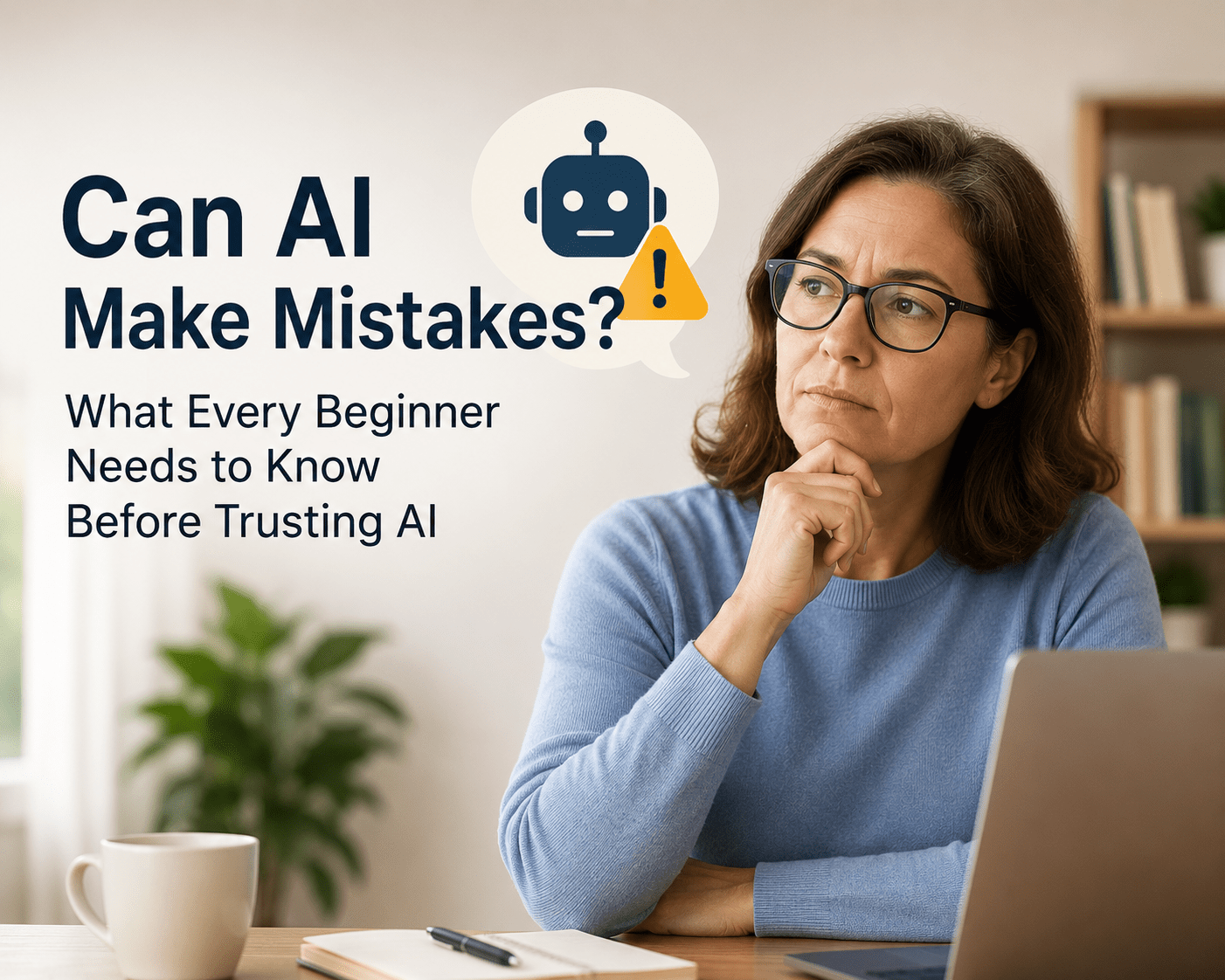
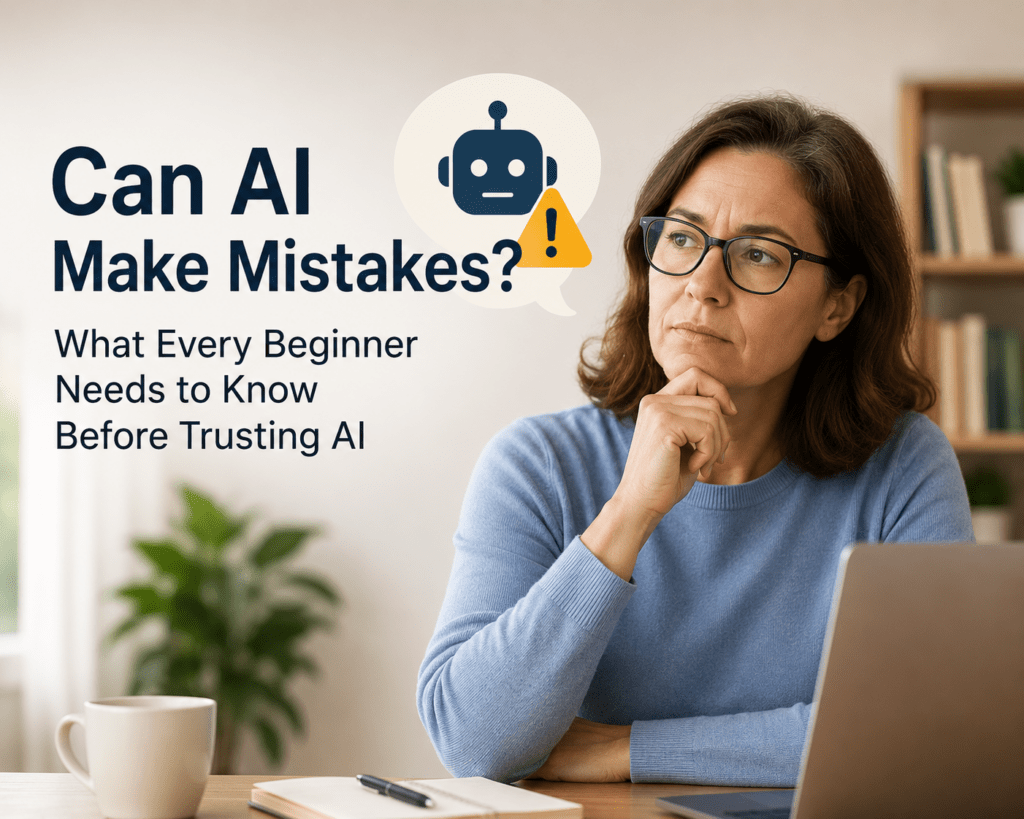
One of the most important questions anyone can ask before relying on an AI tool is also one of the most frequently glossed over in enthusiasm about what AI can do: can AI make mistakes? The honest answer is yes. All AI tools make mistakes, and all major AI tools make them regularly. Understanding specifically how and when AI makes mistakes is what separates people who use AI safely and effectively from people who eventually embarrass themselves or make a costly error based on AI output they should have verified. This guide covers everything a beginner needs to know about AI errors. It talks about what types of mistakes AI makes, why they happen, and which situations carry the highest risk. Finally, it talks about exactly how to protect yourself.
Yes, AI Can Make Mistakes — Here Is Why This Is Not Obvious
The reason AI errors catch people off guard is that AI tools do not look or sound like systems that make mistakes. They respond instantly, confidently, and fluently. Their answers are well-structured and authoritative in tone. There is no hesitation, no hedging, no “I’m not entirely sure about this” — unless the AI has been specifically designed to include such qualifications, which only some are, and only in some situations.
This confident fluency is a feature of how large language models work, not a reflection of their accuracy. AI generates the most statistically plausible response to your input based on its training data. Plausible and accurate are not the same thing. When the most plausible-sounding response happens to be factually wrong, the AI generates it with the same fluent confidence it uses for responses that happen to be correct. There is no internal signal that distinguishes accurate outputs from inaccurate ones in the way a knowledgeable human would feel uncertainty when they were unsure.
Understanding this fundamental characteristic of how AI works is the foundation of using it safely.
The Main Types of AI Mistakes: What Can AI Get Wrong?
AI makes several distinct types of errors. Understanding the difference between them helps you know which situations require the most caution.
Hallucinations — the most dangerous type of AI mistake. A hallucination occurs when AI generates information that is entirely fabricated. This can include invented statistics, fake citations, people who don’t exist, and events that never happened. In fact, it can include laws that were never passed and research that was never conducted. The model presents the hallucination with the same confident fluency as accurate information. There is no warning sign. The AI does not know it is wrong.
Hallucinations occur across all major AI tools, including the most advanced. They are less frequent in newer models than in older ones, but they still happen. They are most common in responses that require specific, verifiable facts — names, dates, statistics, citations, legal references, medical specifics — and least common in responses that involve general explanation of well-established concepts.
Outdated information. AI models are trained on data up to a certain date — their training cutoff. Events, developments, law changes, policy changes, scientific updates, and factual changes that occurred after that date are outside the model’s knowledge. When you ask about something that has changed since the training cutoff, the AI may either say it doesn’t know, give you outdated information as if it were current, or — worst case — hallucinate a plausible-sounding current answer.
Tools with real-time web search — Gemini, Perplexity, and ChatGPT with search enabled — partially address this limitation by retrieving current information. Even then, the synthesis of that information carries the risk of inaccuracy.
Misunderstanding what you asked. AI sometimes misinterprets the intent behind a prompt and answers a slightly different question than the one you asked. This is particularly common when a question is ambiguous, when it requires background context the AI doesn’t have, or when the question involves subtle distinctions the AI doesn’t pick up on. The response is coherent and confident — it is simply an answer to a different question.
Mathematical and numerical errors. Despite their linguistic sophistication, AI tools are surprisingly unreliable for precise numerical reasoning. Simple arithmetic is generally fine. Complex calculations, multi-step mathematical reasoning, statistical analysis, and anything requiring precision in numerical results are areas where AI makes errors more frequently than in language tasks. Always verify AI-produced numbers independently.
Confident overstatement. AI tools sometimes state things with more certainty than the conversation warrants. It may present contested scientific questions as settled, one side of a legitimate debate as the consensus position, or a general tendency as a universal rule. This is not technically a factual error, considering that the information may be accurate. However, the confidence with which the model presents it can mislead users who do not realise the picture is more complex.
Which Situations Carry the Highest Risk of AI Mistakes
Not all AI use carries equal error risk. Understanding which situations are highest risk helps you calibrate how carefully to verify AI output in different contexts.
Medical information. AI tools can explain medical concepts, describe common conditions, and summarise what research says about treatments. They cannot diagnose your specific condition, know your specific medical history, or account for the clinical judgment that a trained doctor applies to your individual situation. Medical information from AI should inform your conversations with healthcare professionals, not substitute for them. An AI error in a medical context can have serious consequences.
Legal information. AI explains legal concepts accurately in general terms. It is unreliable for jurisdiction-specific legal questions, recent case law, and anything where the correct answer depends on specific facts about your situation that require professional legal analysis. Legal errors can be costly and sometimes irreversible.
Financial information. AI explains general principles of personal finance and investment competently. Specific advice about your financial situation — tax implications, investment decisions, pension options — requires a qualified financial adviser who knows your complete picture. AI financial errors can have significant financial consequences.
Anything requiring a specific, verifiable fact. Specific statistics, research findings, historical dates, names, citations, and references are the category most vulnerable to hallucination. Always verify specific facts from AI against primary or authoritative sources before using them in any professional context.
Current events and recent developments. Even tools with web search can mischaracterise recent events or present outdated information as current. For anything where currency matters — legal changes, policy updates, current prices, recent news — verify through authoritative current sources.
How to Protect Yourself From AI Mistakes: A Practical System
Knowing that AI can make mistakes is only useful if it changes how you use AI. The following system protects you from the most consequential errors without eliminating the practical benefits of AI assistance.
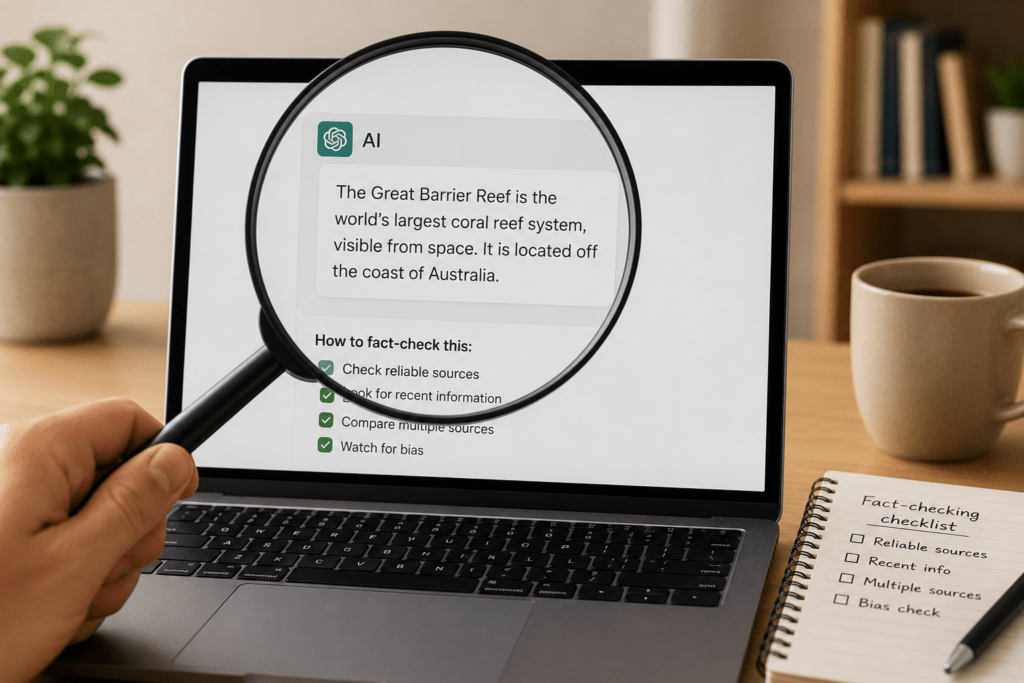
Calibrate verification effort to consequence. Not every AI output needs the same level of verification. For low-stakes tasks — drafting a casual email, brainstorming ideas, summarising a document you can cross-check — a quick review is sufficient. For high-stakes outputs, verify every specific factual claim independently. This includes anything medical, legal, financial, or that will be published or shared professionally. Verify every specific factual claim independently. The effort invested in verification should be proportional to the consequences of the error.
Treat specific facts as guilty until proven innocent. When AI produces a specific statistic, citation, name, or date, treat it as unverified until you have checked it against a primary source. This is not cynicism — it is rational behaviour given the known frequency of hallucinations for specific facts.
Ask AI to show its reasoning. For complex questions, ask Claude or ChatGPT to explain how it arrived at its answer: “Please walk me through your reasoning step by step.” Errors are often easier to spot in the reasoning than in the conclusion, and the process of explaining the reasoning sometimes causes the AI to self-correct.
Use AI outputs as starting points, not endpoints. The most robust approach to AI assistance treats AI output as a first draft to verify and improve rather than a finished product to accept. This is the posture that protects you from errors while maximising the genuine efficiency gains AI provides.
Cross-check important information with multiple sources. For anything significant, do not rely on a single AI response. Ask the same question differently, or ask a different tool, and compare the answers. Significant discrepancies are a strong signal that you may need independent verification.
What AI Is Getting Better At — and What Remains Genuinely Difficult
It is worth being clear that AI error rates are declining over time. Newer models hallucinate less frequently than older ones, handle nuance and ambiguity more accurately, and are more reliably able to say “I don’t know” when they genuinely don’t know. The trajectory is clearly towards greater accuracy.
However, the specific types of errors that AI makes are unlikely to disappear entirely in the near term. The fundamental architecture of large language models — generating plausible sequences based on training data — is not well-suited to guaranteeing factual accuracy for highly specific claims. This is a structural characteristic, not a bug that requires fixing in the next model update.
The realistic picture for 2026 and the near future is AI tools that are genuinely useful, increasingly accurate, and still imperfect in ways that require ongoing human verification for anything important. That picture — useful and imperfect simultaneously — is the one that allows you to use AI confidently and safely, without either ignoring the risks or being paralysed by them.
For context on the full range of AI capabilities alongside these limitations, our guide to what AI can realistically do covers both sides of the picture. For practical guidance on identifying and avoiding AI errors in specific high-stakes contexts, our guide to fact-checking AI output provides detailed techniques — and for a broader picture of the privacy and safety considerations that apply to AI use generally, our AI safety guide covers the wider landscape.


AI makes mistake too. There was a time ChatGPT made grammatical error when I asked a question. I was shocked 😂.