

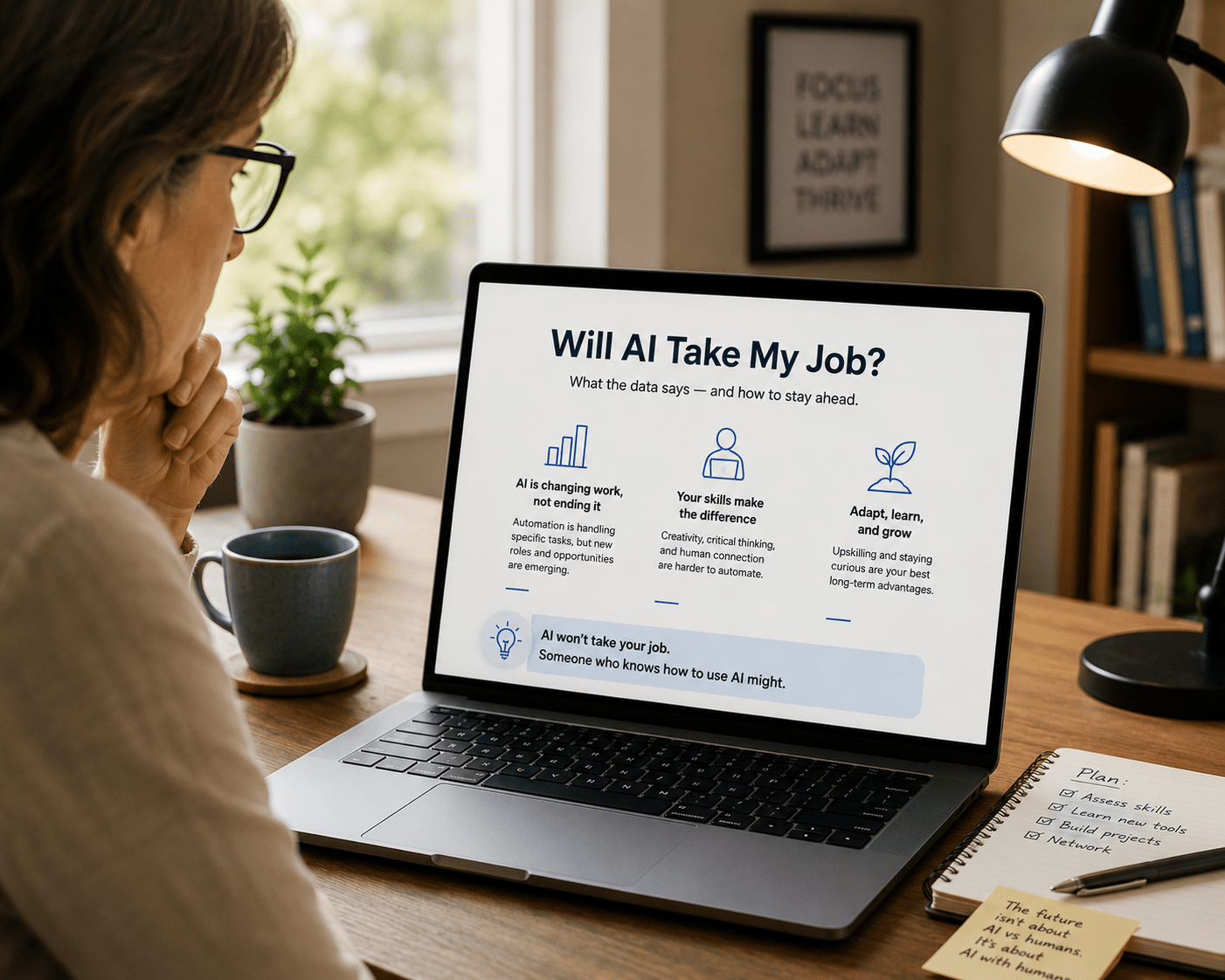
The question of whether AI will take your job is one of the most anxiety-provoking questions of the current moment — and it is consistently answered in one of two equally unhelpful ways. Either with breathless alarm that paints a picture of imminent mass unemployment, or with breezy dismissal that tells you not to worry because technology always creates more jobs than it destroys. Both responses fail the person actually asking the question, because the real answer depends entirely on what job you have, what parts of that job AI can and cannot do, and what the realistic timeline of change looks like for your specific situation. This guide gives you that honest, specific answer rather than a generalisation in either direction.
Why “Will AI Take My Job?” Is the Wrong Question
The framing of the question itself contains an assumption worth examining: that AI either takes a job or doesn’t — that the outcome is binary. In reality, the relationship between AI and employment is considerably more nuanced, and understanding that nuance is what makes the answer useful rather than frightening.
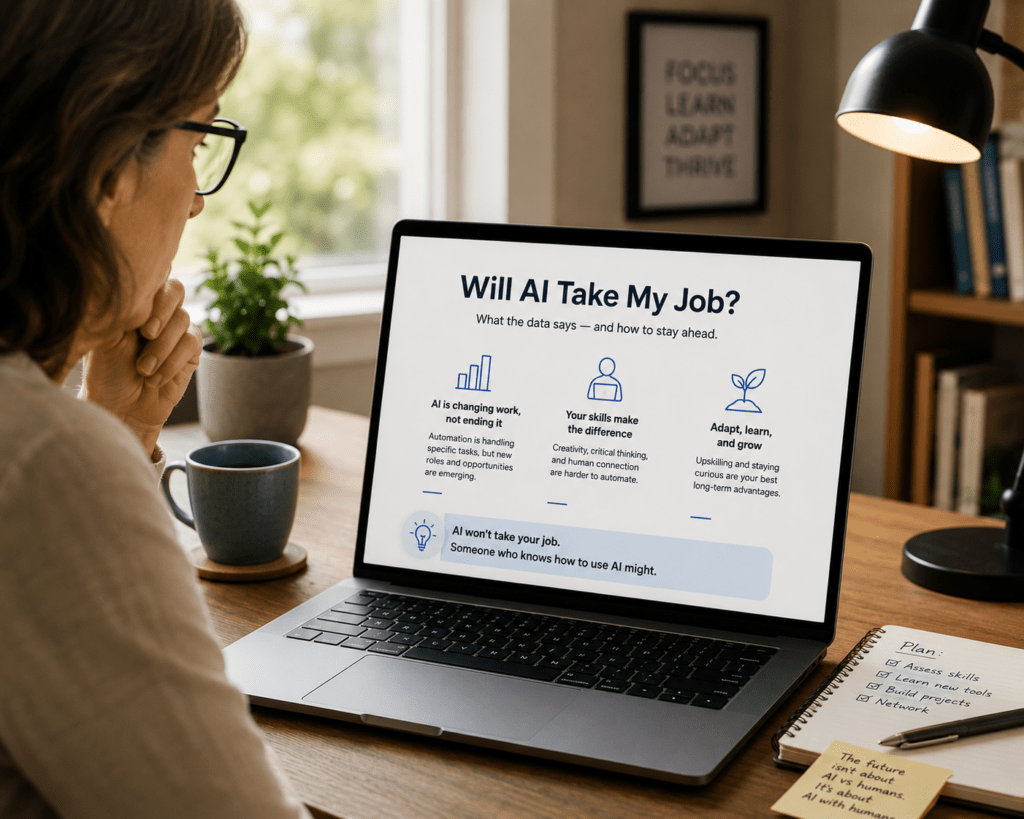
What AI is currently doing — and what it will continue to do over the next several years — is automating specific tasks within jobs rather than jobs as a whole. A job is a bundle of tasks. Some of those tasks are well-suited to AI automation. Others are not. The question that actually determines your employment security is not “will AI take my job?” but rather “what proportion of my job’s tasks can AI automate, and what happens to the remaining tasks?”
For most jobs, the answer to that question is: AI can automate a meaningful but minority portion of the tasks, the remaining tasks become more valuable, and the people who learn to use AI for the automatable portion become more productive and therefore more competitive than those who don’t. This is a different and considerably less alarming picture than wholesale job replacement.
The Jobs Where AI Poses the Highest Risk
Being honest about this question means acknowledging that some jobs and some people face genuine risk — not just change, but potential displacement. Pretending otherwise would be misleading.
The jobs at highest risk share a common characteristic: they consist primarily of a single, well-defined, repetitive cognitive task that can be precisely specified and produces a consistent output. The following categories face genuine disruption.
Routine data processing and entry. Jobs that consist primarily of entering, categorising, or moving data between systems — data entry clerks, certain administrative roles, basic bookkeeping positions — face significant automation risk because these tasks are precisely the type that AI systems handle well. The timeline for this automation is already underway rather than future-tense.
Basic content production. Roles that produce high volumes of formulaic written content — certain types of journalism (press release-based news articles, financial data summaries, sports scores reporting), basic marketing copywriting, product description writing, and similar volume-content roles — face genuine displacement risk because AI produces this content faster, cheaper, and at comparable quality for the formulaic end of the spectrum.
Basic customer service and call handling. Roles that handle a defined range of customer queries with scripted or near-scripted responses — first-line call centre agents, basic customer service chat handlers, routine helpdesk functions — are already being substantially automated. The more complex, judgment-intensive, and emotionally demanding the customer interaction, the more human involvement remains necessary.
Certain legal and financial processing roles. Paralegal work that involves reviewing documents for specific clauses, certain accounting tasks that involve applying fixed rules to structured data, and similar roles where the task is essentially pattern-matching in a well-defined domain face meaningful automation pressure.
The Jobs Where AI Poses the Lowest Risk
At the other end of the spectrum, certain categories of work face minimal displacement risk from current AI, and understanding why helps clarify the underlying principle.
Physical, manual, and dextrous work. AI cannot currently operate in the physical world with anything approaching human dexterity, adaptability, and contextual judgment. Plumbers, electricians, carpenters, nurses who perform physical patient care, chefs, mechanics, and the full range of skilled trades involve physical problem-solving in varied, unpredictable environments that AI cannot navigate. The timeline for physical automation of this type of work is substantially longer than for cognitive automation, and the investment required makes it economically unviable for most applications.
High-stakes professional judgment. Doctors making complex diagnostic and treatment decisions, lawyers making strategic case judgments, therapists and counsellors, experienced managers navigating complex organisational situations — these roles require the synthesis of deep domain expertise, contextual judgment, professional accountability, and interpersonal skill in ways that AI currently supports but cannot replace. AI is a tool these professionals use; it is not a substitute for their judgment.
Creative work requiring genuine originality and cultural judgment. The AI-generated content that currently exists is derivative — it synthesises from what already exists. Work that requires genuine cultural originality, strategic creative judgment, and the ability to anticipate what will resonate with a specific audience at a specific cultural moment — the higher end of creative direction, strategy, brand narrative, and cultural production — remains substantially human.
Roles built on human relationships and trust. Sales roles that depend on deep long-term client relationships, leadership roles that depend on trust and the ability to inspire and develop people, advisory roles where the value is inseparable from the specific person providing the advice — these resist automation not because of technical limitations but because the human relationship is part of what is being purchased.
What the Evidence Actually Shows About AI and Employment
Moving beyond speculation to what is actually happening in labour markets in 2026 provides a more grounded picture than either alarm or reassurance.
The evidence to date shows job displacement concentrated in specific sectors and task types, with overall employment holding relatively stable — not because AI is not having an effect, but because new roles are being created alongside the displacement of existing ones. The new roles are primarily in AI oversight, implementation, and augmentation — people who manage AI systems, who evaluate AI outputs, who train AI models on domain-specific data, and who use AI tools to do jobs that previously required more people or more time.
Furthermore, productivity gains from AI are translating into expanded output in many sectors rather than reduced headcount — companies are producing more with the same number of people rather than the same amount with fewer people, at least in the near term. This may not hold indefinitely as AI capabilities expand, but the immediate effect is expansion rather than contraction in most sectors.
The most reliable predictor of employment security in an AI-affected economy is not the sector you work in but your relationship with AI tools themselves. People who use AI to augment their work — who are faster, more capable, and more productive because of AI — are more competitive than people who perform the same tasks manually. The people most at risk are not those whose jobs involve tasks AI can do, but those who refuse to learn to use AI for those tasks and therefore become less competitive relative to colleagues who do.
How to Audit Your Own Job’s AI Risk
Rather than relying on general assessments, you can evaluate your own situation specifically by working through the following questions — ideally with AI assistance, which produces the useful irony of using AI to understand your AI risk.
Ask Claude or ChatGPT: “Here is a description of my job and the main tasks I perform on a daily and weekly basis: [describe your job in detail]. Please assess which of these tasks are currently most susceptible to AI automation, which are least susceptible, and what the realistic timeline looks like for each. Then tell me what skills or capabilities I should develop to remain competitive in this role as AI capability increases.”
The resulting assessment is more specific and more useful than any generic job-category risk assessment, because it engages with the actual tasks of your actual job rather than a generalisation about your industry.
What to Do If Your Job Is at Risk
If an honest assessment of your situation suggests genuine risk, the productive response is neither panic nor denial. It is specific action in the near term.
Learn to use AI tools that are relevant to your field. The person who knows how to use AI to do their job faster and better is more valuable than the person who resists it — and considerably more employable than the person who is replaced by it. Our beginner’s guide to getting started with AI covers the practical first steps.
Identify the human-irreplaceable elements of your current role and invest in developing those capabilities. The tasks that AI cannot do — judgment, relationship, creativity, physical skill, professional accountability — are the tasks worth building depth in.
Consider adjacent roles that are less exposed. If your current role is primarily automatable tasks, a move into a related role with more judgment-intensive or relationship-intensive content is a rational risk-management move rather than an overreaction.
Develop AI literacy as a transferable skill in its own right. The ability to work effectively with AI tools — knowing which tools to use, how to prompt them well, how to evaluate their outputs critically — is itself a competitive skill across industries, as covered in our guide to using AI to learn new skills.


Very insightful.
AI is really taking over jobs this days. What I have learnt from this is to actually learn more about AI tools related to my field.
In this era where AI seems to be threatening jobs in the digital space, this is refreshing to know.