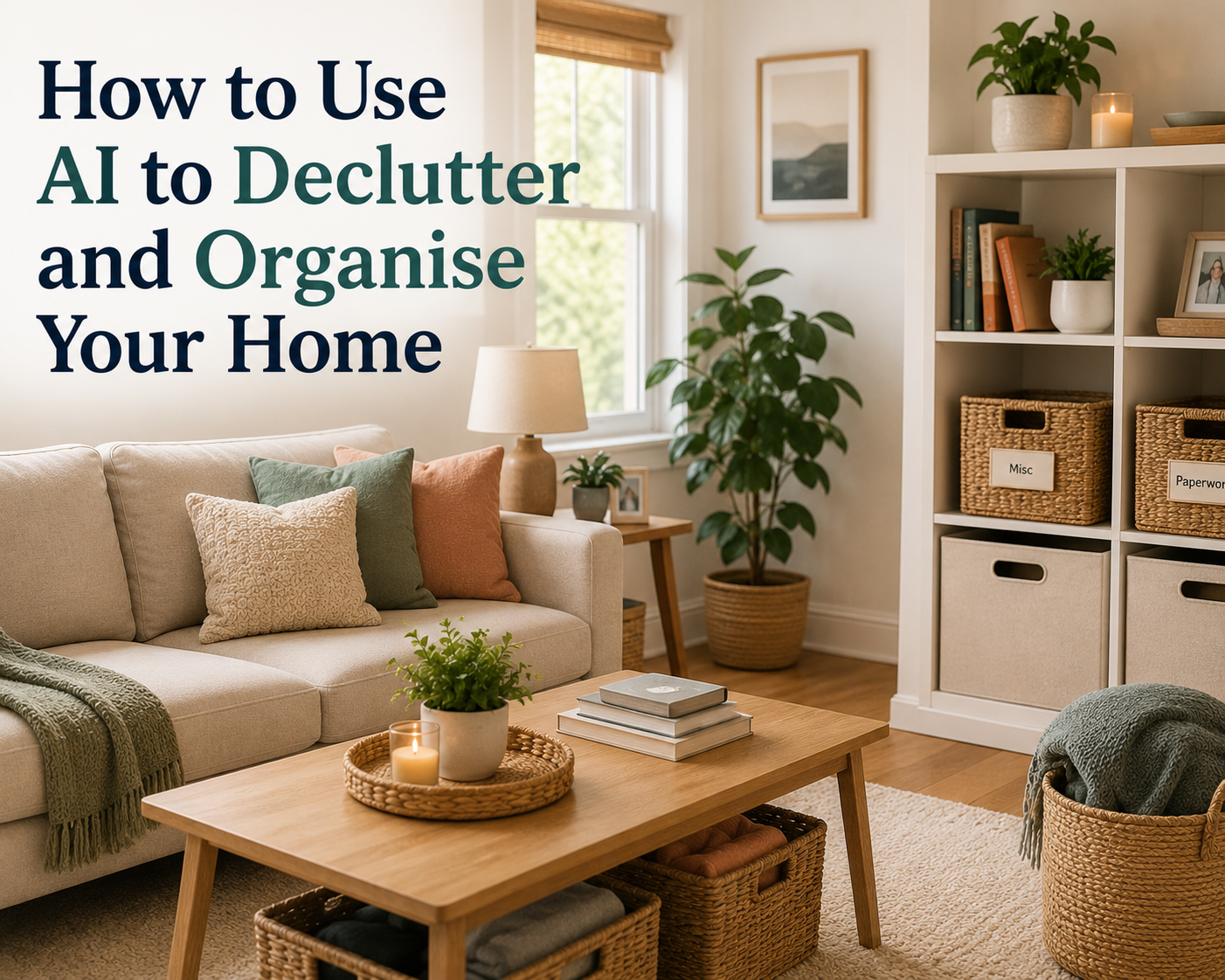
The problem with most decluttering advice is that it assumes you already have the energy, the time, and the mental clarity to execute a complete home overhaul on a free weekend. In reality, most people who want to declutter and organise their home are already overwhelmed. By the scale of the task, by indecision about what to keep and what to let go of, and by the paralysis that sets in when everything feels equally urgent and equally impossible. Learning how to use AI to declutter and organise your home works because it removes the decision fatigue and the blank-page problem from the process entirely. Instead of staring at a cluttered room, wondering where to start, you have a conversation, answer some questions, and end up with a personalised, room-by-room plan that fits your actual life. This guide shows you exactly how to do it.
Why Decluttering Attempts Usually Fail — and What AI Changes
Most decluttering attempts fail at one of three points. The first is before they start. At this point, the task feels so large and so undefined that it never gets going. The second is in the middle. Here, momentum runs out after the first room because there is no clear plan for what comes next. The third is after completion. This is the point where things slowly drift back to how they were because the person decluttering put no sustainable organisational system in place.
AI addresses all three failure points directly. It helps you start by breaking the task into manageable, clearly defined steps. It keeps you going by providing a complete plan that shows what comes after each stage. Finally, it helps you set up systems that prevent things from drifting back, because the systems are designed around your specific habits and constraints rather than someone else’s ideal version of how a home should work.
Furthermore, AI is particularly useful for the specific decisions that cause most people to get stuck. For example, what to do with items that have sentimental value but no practical use, how to organise a space that has to serve multiple purposes, and what storage solutions actually work for the way you live rather than for a magazine photoshoot.
How to Use AI to Declutter and Organise Your Home: Starting the Right Way
The most effective way to begin using AI to declutter and organise your home is not to ask for a generic decluttering plan. Generic plans are available everywhere. However, they consistently fail to account for you specifically. They do not know the specific constraints, priorities, and obstacles that make your situation different from the hypothetical average household.
Instead, start by giving the AI a detailed picture of your situation. Open Claude or ChatGPT and use this opening prompt: “I want to use AI to declutter and organise my home, but I’ve tried before and got stuck. Before you give me any advice, please ask me ten questions about my home, my lifestyle, my main challenges, and what has stopped me before. I want a plan that is genuinely tailored to my situation, not a generic decluttering checklist.”
Answer each question fully and honestly. The AI will likely ask about the size and layout of your home. It may ask about the rooms that bother you most, as well as your household composition. It may also go a bit more personal by asking about your relationship with keeping things, your available time, and any physical or practical limitations. Finally, it may ask you what your definition of “organised” actually looks like. These answers become the foundation of a plan that fits your life rather than imposing an external ideal onto it.
Building Your Room-by-Room AI Decluttering Plan
Once the AI understands your situation, ask it to produce a prioritised, room-by-room decluttering and organisation plan. The keyword is prioritised. Not everything is equally urgent. A plan that starts with the rooms that cause the most daily friction produces faster visible improvement and more motivation to continue.
“Based on everything I’ve told you, please create a room-by-room plan for decluttering and organising my home. Start with the rooms or areas that cause me the most daily stress or friction. For each room, give me: a clear order of attack within the room and the specific decisions I’ll need to make. Also, include the common mistakes to avoid, and what ‘done’ looks like for that space. Make the plan realistic for someone with [your available time] per week.”
The resulting plan gives you a clear, sequenced roadmap. You do not just get a list of rooms to tackle. Instead, you get a specific approach for each one that accounts for the particular challenges of that space. Working through the kitchen is different from working through a home office, which is different from working through a child’s bedroom. The AI tailors the approach to each space based on what you’ve told it about how each room is used and what the problems are.
Using AI to Make the Specific Decisions That Cause Paralysis
The decisions that stop most people mid-declutter are not the obvious ones. Nobody agonises over whether to throw away a broken umbrella. The decisions that cause paralysis are the ones with genuine ambiguity. These include the item that might be useful someday, the gift that carries emotional weight but serves no practical purpose, and the collection that made sense ten years ago and hasn’t been looked at since.
AI is a remarkably useful thinking partner for these specific decisions. It does not decide for you, but it asks the questions that clarify your thinking faster than internal deliberation alone.
When you are stuck on a specific item, describe it to the AI and ask for help thinking it through. “I have a box of items from my parents’ house that I don’t use and don’t particularly want to display, but feel guilty getting rid of. How do I think through this kind of decision without just postponing it indefinitely?”
The AI responds with a structured set of questions — would someone else in the family want these? Is it the object itself that matters or the memory? Could you keep one representative item and let the rest go? Could you photograph them before they leave? — that move you through the decision rather than around it. This conversational approach to decision-making is one of the most practically useful ways to use AI to declutter and organise your home, because it is precisely where human decision-making most commonly stalls.
How to Use AI to Design an Organisational System That Actually Works for You
Decluttering and organising are two different tasks. Decluttering removes what doesn’t belong. Organising creates a system that makes it easy to keep what belongs in its place. Most people invest in the first and underinvest in the second, which is why things drift back.
AI helps you design organisational systems based on your actual behaviour rather than idealised behaviour. This distinction matters enormously. A filing system that works perfectly for someone who naturally puts things away immediately is useless for someone who creates temporary piles before filing. A kitchen organisation that assumes you cook from scratch daily is wrong for someone who cooks twice a week. The right system is the one that works with how you actually live, not against it.
Use this prompt once you’ve cleared a space: “I’ve finished decluttering [room or area]. Here is how the space is used and by whom: [describe it]. Here are my honest habits — including the ones that aren’t ideal: [describe them]. Suggest an organisational system for this space that works with my actual habits rather than assuming I’ll develop new ones. Prioritise sustainability over perfection.”
The AI produces suggestions that are practical, habit-aware, and specific to your space. Not the generic “use matching containers and label everything” advice that looks good on Instagram and lasts three weeks in practice.
Using AI to Create a Maintenance System
The most common outcome of a successful declutter is a return to approximately the original state within six to twelve months. This is not a character flaw — it is a systems failure. Without a maintenance system, entropy wins every time.
AI helps you design a maintenance system that is simple enough to actually sustain. After organising each room, ask: “Based on the organisational system we’ve designed for this space, what is the minimum ongoing maintenance this space needs to stay organised? Design a simple weekly and monthly routine that takes the least possible time while preventing things from drifting back.”
The resulting routine is specific to your space and your system. Not a generic “tidy up for twenty minutes every Sunday” instruction, but a specific set of actions tied to the specific organisational decisions you made. This specificity is what distinguishes a maintenance routine you follow from one you intend to follow.
Additionally, ask the AI to help you design what professional organisers call a “one in, one out” policy for the categories that tend to accumulate most in your home: “The area that keeps filling back up is [describe it]. Can you help me design a simple rule or habit that prevents this specific type of accumulation from happening again?”
How to Use AI to Organise Specific Problem Areas
Certain areas of the home present specific organisational challenges that generic advice handles poorly. Three of the most common are worth addressing in detail.
The paperwork pile. Physical paperwork — bills, letters, school forms, instruction manuals, receipts — accumulates in most homes despite the supposed arrival of the paperless era. AI helps you design a simple paperwork processing system: what to keep, for how long, in what format, and how often to process the incoming pile. “I have a significant backlog of physical paperwork and no system for dealing with it. Please help me design a simple system for clearing the backlog and preventing it from accumulating again, assuming I can spend about thirty minutes per week on it.”
The digital equivalent — photo and document chaos. Thousands of unsorted photos, documents scattered across multiple devices, files with names like “final_v3_ACTUAL_FINAL” — digital clutter causes its own particular stress. AI guides the organisation approach: “I have years of unsorted digital photos and documents across multiple devices. Help me design a simple, sustainable system for organising them that doesn’t require hours of upfront effort to set up.”
Children’s belongings. Managing the constant inflow of children’s artwork, clothing they’ve outgrown, toys they’ve moved on from, and school materials requires a system that accommodates both the emotional dimension — some of this matters, a lot of it doesn’t — and the practical constraint that children’s belongings multiply faster than adult ones. “My children’s rooms and the shared spaces in our home are constantly overwhelmed with their belongings. Help me design an age-appropriate system for managing this that involves the children rather than working around them.”
A Realistic Timeline for Using AI to Declutter and Organise Your Home
One of the most useful things AI can do for a decluttering project is help you set realistic expectations. Most homes accumulate years of possessions, and the idea that the whole thing can be transformed in a weekend is a setup for disappointment and giving up.
Ask your AI tool to help you build a realistic project timeline: “Based on what I’ve told you about the size of my home, the amount of decluttering needed, and the time I have available, give me a realistic timeline for completing this project. Break it down into phases, tell me what I should be able to achieve in the first month, and set honest expectations for how long it will take to reach the point where the whole home feels genuinely organised.”
A realistic timeline with clear phase milestones transforms a vague, overwhelming project into a manageable series of achievable steps. It also makes it much easier to sustain motivation, because you know that the current difficulty is a phase rather than a permanent state.
For context on the broader range of tasks AI can support in your personal life, our guide to what AI can realistically do and our introduction to AI tools cover the capabilities and limitations that apply across all these use cases.