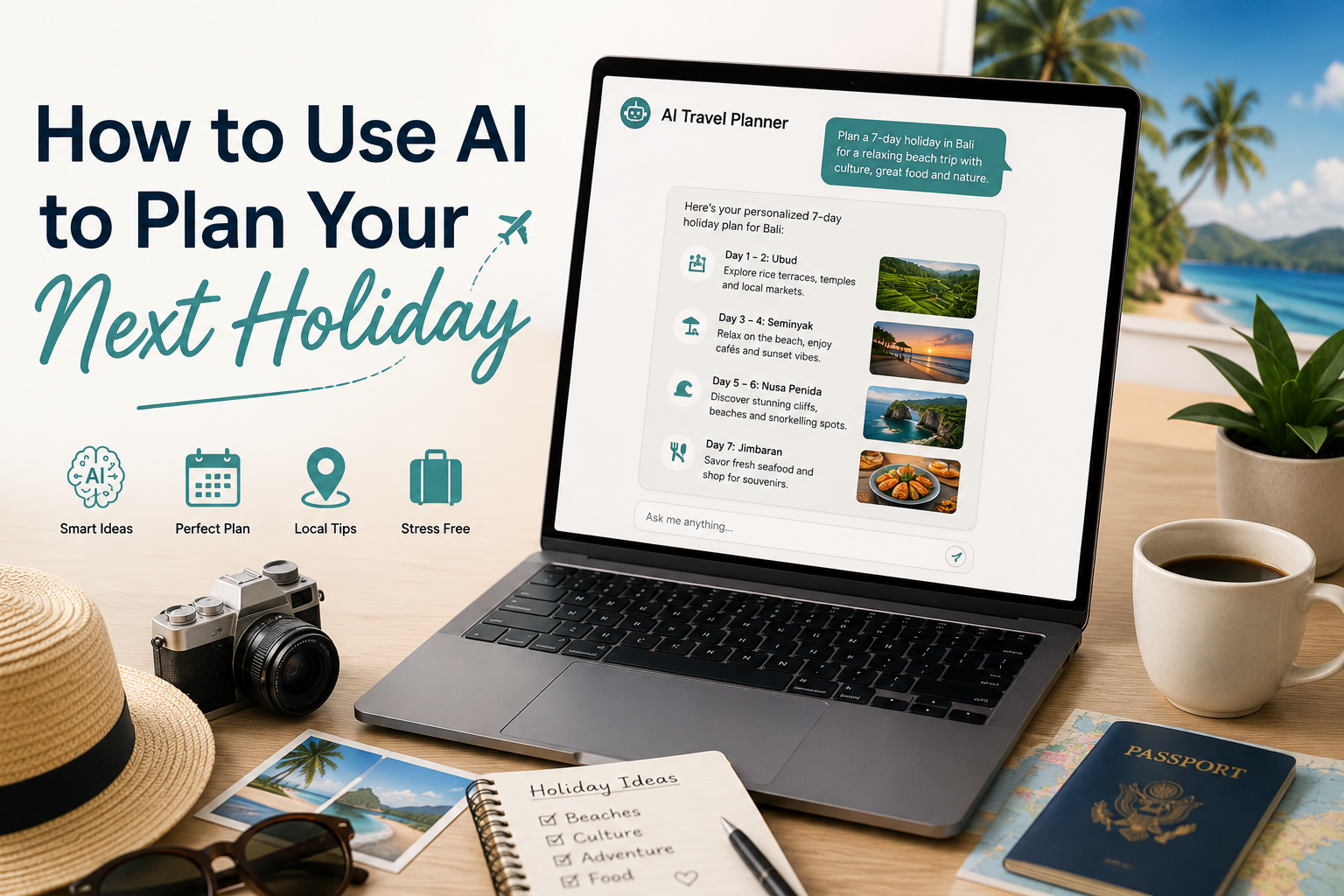
Holiday planning sits in an awkward middle ground — too complex to sort out in five minutes, but not complex enough to justify hiring a travel agent for most trips. The result is that most people spend several unfocused hours spread across multiple websites, browser tabs, and recommendation lists before producing something that still feels incomplete. Learning how to use AI to plan a holiday consolidates this process dramatically. AI tools act as a knowledgeable, patient travel planning partner that remembers everything you’ve told it, answers follow-up questions instantly, and produces structured itineraries, packing lists, and travel information on demand. This guide walks through the entire process from first conversation to final itinerary.
What AI Does Well in Holiday Planning
Before starting the planning process, it helps to understand where AI adds the most value and where its limitations require supplementing with other sources.
AI is excellent at destination research — synthesising information about places, activities, neighbourhoods, and travel logistics into clear, useful summaries. It is strong at itinerary building — taking your preferences, constraints, and trip length and producing a logical, day-by-day plan. It handles packing lists, restaurant area recommendations, cultural context, and practical travel information competently. Furthermore, it remembers everything you’ve told it within the conversation, which means it builds up a personalised picture of your trip as you develop it together.
Where AI requires supplementing is real-time accuracy. Flight prices, hotel availability, current entry requirements, and local conditions change constantly. AI’s knowledge has a training cutoff, and even tools with web search capability may not have the most current booking information. Always verify flights, accommodation, and entry requirements through official or booking-specific sources before making any reservations.
How to Use AI to Plan a Holiday
Step 1: Define What You Actually Want From This Trip
The most common reason holiday planning stalls is that people start researching destinations before they’ve clarified what they actually want from the holiday. AI helps with this crucial first step by asking the right questions.
Start with this prompt: “I’m planning a holiday and want your help. Before we get into destinations, please ask me ten questions about what I’m looking for — travel style, budget, travel companions, time of year, what I want to feel or experience, and what I want to avoid.”
Answer each question honestly. The resulting conversation produces a clear picture of what kind of holiday will actually serve you, which then guides every subsequent decision. This step takes ten to fifteen minutes and prevents the much larger waste of time that comes from researching holidays that aren’t right for you.
Step 2: Research Destinations
With your preferences clear, ask AI to suggest destinations that genuinely fit your criteria. Rather than accepting the first suggestion, use the conversation to explore options and trade-offs.
“Based on what I’ve told you about what I’m looking for, please suggest five destinations that would suit me well. For each one, briefly explain why it fits my criteria and flag any significant downsides or trade-offs I should consider.”
Work through the suggestions conversationally — ask follow-up questions about specific aspects of each destination, compare two that appeal most, and ask AI to help you make the final decision based on your priorities. “Between [Destination A] and [Destination B], which is the better fit for someone who values [your priority] over [other consideration]?”
Use Perplexity to supplement this research with current information — travel advisories, recent visitor experiences, and any significant changes to access or conditions that may not be in Claude’s training data.
Step 3: Build a Day-by-Day Itinerary
Once you’ve chosen your destination, AI’s itinerary-building capability is where it becomes most immediately useful. Provide your trip parameters — number of days, your base location, your interests, your pace preference — and ask for a structured plan.
“I’m spending [X] days in [destination], staying in [area or accommodation]. I’m interested in [your interests — history, food, nature, art, relaxation]. I prefer a [relaxed / moderate / packed] pace. Please build me a day-by-day itinerary that includes morning, afternoon, and evening suggestions for each day, with brief notes on why each activity suits my interests and any practical tips.”
The resulting itinerary gives you a structured starting point for your trip. Use it as a foundation rather than a rigid schedule — ask follow-up questions about specific days, ask for alternatives if something doesn’t appeal, and ask the AI to factor in any additional preferences or constraints as they emerge.
Step 4: Research Practical Information
With your itinerary in place, use AI to gather the practical information you need before travelling. This covers a lot of ground — and AI consolidates it faster than working through multiple sources manually.
Useful prompts for this phase include: “What are the most important cultural customs I should be aware of in [destination]?” and “What is the best way to get from [airport] to [area] on arrival?” and “What do visitors commonly wish they’d known before visiting [destination]?” and “What should I pack for [destination] in [month], given that I’m planning [activities]?”
For entry requirements — visas, vaccination requirements, passport validity rules — use the official government travel advice website for your country rather than AI, as this information changes and the consequences of error are significant.
Step 5: Create a Packing List
AI generates highly personalised packing lists based on the trip you’ve described — destination, season, activities, duration, and your travel style. This is considerably more useful than a generic packing list because it reflects the actual requirements of your specific trip.
“Based on the holiday we’ve planned — [destination], [duration], [activities], [time of year] — please create a comprehensive packing list organised into categories. Flag anything that is particularly important for this destination that people commonly forget.”
Review the list against your existing travel kit and use it as a checklist when packing. For most trips, an AI-generated packing list is more thorough than what most travellers produce manually, and it is tailored to your trip rather than generic.
Getting the Most From AI Travel Planning
The key to effective AI holiday planning is treating it as an ongoing conversation rather than a single query. The more context you provide, the more useful the output. The more you explore options and trade-offs through dialogue, the better the final decisions.
Start your holiday planning earlier than you normally would — the conversational exploration of destinations and itinerary options is valuable in itself, not just as a means to a booking. Many people find that the AI planning conversation surfaces destinations and experiences they hadn’t considered and helps them get clearer on what they actually want from travel in ways that generic browsing doesn’t.
For practical booking — flights, accommodation, tours — AI planning points you in the direction, and then dedicated booking platforms handle the actual reservation. This division of labour — AI for research, planning, and itinerary building; booking platforms for actual reservations — makes the overall process faster and more informed than either approach alone.
Remember that there is a limit to what AI can realistically do, and plan appropriately.