A business plan is one of those documents that feels more intimidating than it needs to be. The term conjures images of complex financial projections, market analysis tables, and business school frameworks that most aspiring entrepreneurs don’t feel qualified to produce. In reality, a useful business plan for a new or early-stage business is a clear, structured document that forces you to think through the key aspects of your idea — and AI makes producing that document significantly more accessible than the traditional approach. This guide shows you how to use AI to create a business plan, step by step, without any business training or financial expertise.
What a Good Business Plan Actually Needs to Do
Before using AI to build your plan, it helps to understand what a useful business plan is actually for. At the early stage, a business plan serves two purposes. First, it forces you to think through whether your idea is viable — the market, the customers, the costs, the revenue model, and the competition — before investing significant time and money. Second, if you need external funding or a formal loan, it communicates your thinking clearly to the people making that decision.
A business plan does not need to be perfect. It does not need to contain sophisticated financial modelling. It needs to demonstrate that you’ve thought clearly about the key questions every business faces, and that your answers are internally consistent. AI helps you work through these questions systematically and produce a document that reflects your thinking clearly.
How to Use AI to Create a Business Plan – Step 1: Define Your Business Idea Clearly
Start by asking AI to help you articulate your business idea precisely. Many business ideas that seem clear in the founder’s head become fuzzy when written down — which is a useful signal to encounter early. Use this prompt as your starting point:
“I want to start a business and need help creating a business plan. Here is my idea: [describe your idea]. Please ask me ten clarifying questions that will help us develop this idea into a clear, viable business concept before we start writing the plan.”
Answer each question as specifically as you can. This dialogue surfaces assumptions you may not have examined, identifies gaps in your thinking, and produces a much clearer starting point for the plan itself. After answering all ten questions, ask the AI to summarise what it’s learned: “Based on my answers, please write a one-paragraph summary of the business concept.”
How to Use AI to Create a Business Plan – Step 2: Analyse the Market and Competition
With your business concept clear, use Perplexity to research the market you’re entering — its size, its trends, and the competitors already operating in it. This research grounds your plan in current, factual information rather than assumptions.
“Please research the market for [describe your business type] in [your target geography]. I want to understand: how large the market is, what the key trends are, who the main competitors are, and what gaps or opportunities appear to exist.”
Paste the Perplexity research results into Claude and ask it to synthesise the findings into a market analysis section for your business plan. “Based on this market research, please write a market analysis section for my business plan that covers market size and trends, key competitors and their positioning, and the opportunity my business is targeting.”
How to Use AI to Create a Business Plan – Step 3: Define Your Target Customer
A business plan without a specific, clear description of the target customer is built on a vague foundation. AI helps you sharpen your customer description by asking the right questions and producing a clear, specific customer profile.
“Based on the business concept we’ve developed, please help me create a detailed target customer profile. Who specifically is most likely to buy from me? What are their characteristics, their needs, their motivations, and the problem my business solves for them? Please ask me any questions you need to produce a specific, credible profile.”
The resulting customer profile becomes the lens through which every other element of the plan is evaluated — the marketing approach, the pricing, the channel choices, and the product or service development priorities.
How to Use AI to Create a Business Plan – Step 4: Develop Your Revenue Model
The revenue model is often the section of a business plan that aspiring entrepreneurs find most difficult to produce credibly. AI helps by working through the logic step by step rather than asking you to produce a financial table from nothing.
“I need to develop the revenue model for my business plan. Here is what I know: [describe your pricing approach, the number of customers you expect to serve, and any relevant cost information]. Please help me calculate a simple monthly revenue projection for the first year, showing what I need to sell at what price to cover my costs and achieve [your target]. Ask me any questions you need to make this realistic.”
The AI works through the calculation with you, surfaces any inconsistencies — “Your cost estimate of £X means you need to sell Y units at your proposed price to break even, which requires Z customers. Does that seem realistic given your market?” — and produces a structured financial summary you can include in the plan.
How to Use AI to Create a Business Plan – Step 5: Write the Complete Business Plan
With all the elements developed, ask Claude to compile them into a complete, formatted business plan document.
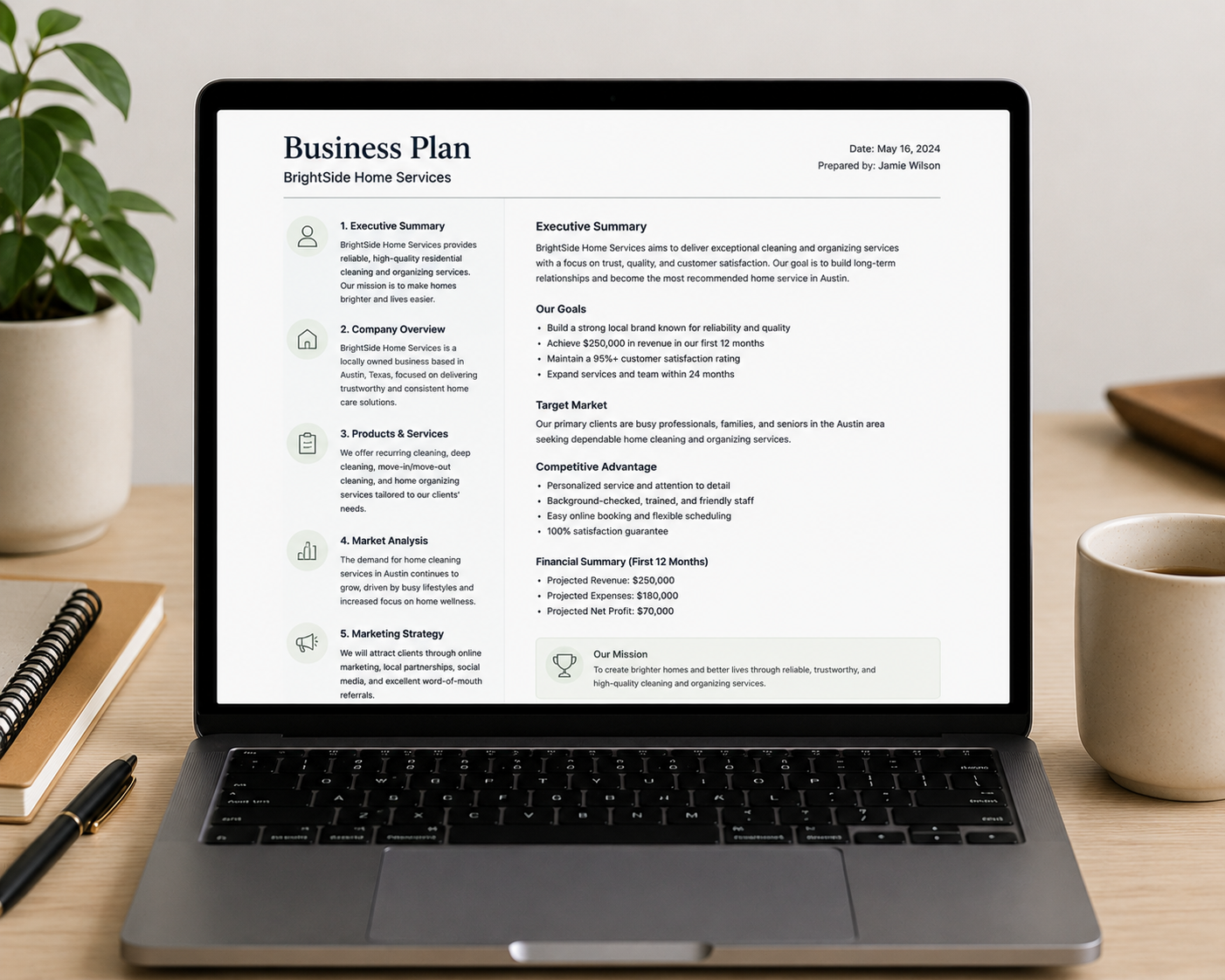
“Based on everything we’ve developed — the business concept, market analysis, target customer profile, and revenue model — please write a complete business plan with the following sections: Executive Summary, Business Description, Market Analysis, Target Customer, Products and Services, Marketing Strategy, Operational Plan, Financial Projections, and Next Steps. The plan should be clear, professional, and approximately [X] pages long.”
The resulting document will require review and personalisation — add specific details, correct anything that doesn’t reflect your thinking accurately, and adjust the financial figures based on your own knowledge of costs. But the structure, the language, and the logical flow that make a business plan readable and credible will all be in place.
Important Caveats
As our guide to what AI can realistically do makes clear, AI provides a structured starting point rather than expert advice. For a business plan intended for a bank loan, an investor, or a government grant application, have it reviewed by a business adviser or accountant before submission. The plan AI helps you produce is a strong foundation — not a guarantee of accuracy or of the financial projections it contains.
Furthermore, the best business plan is the one that reflects your genuine thinking and honest assessment of your idea’s viability. Use AI to structure and articulate your thinking, not to paper over genuine uncertainties with confident-sounding language. The questions that feel difficult to answer are often the most important ones to sit with.