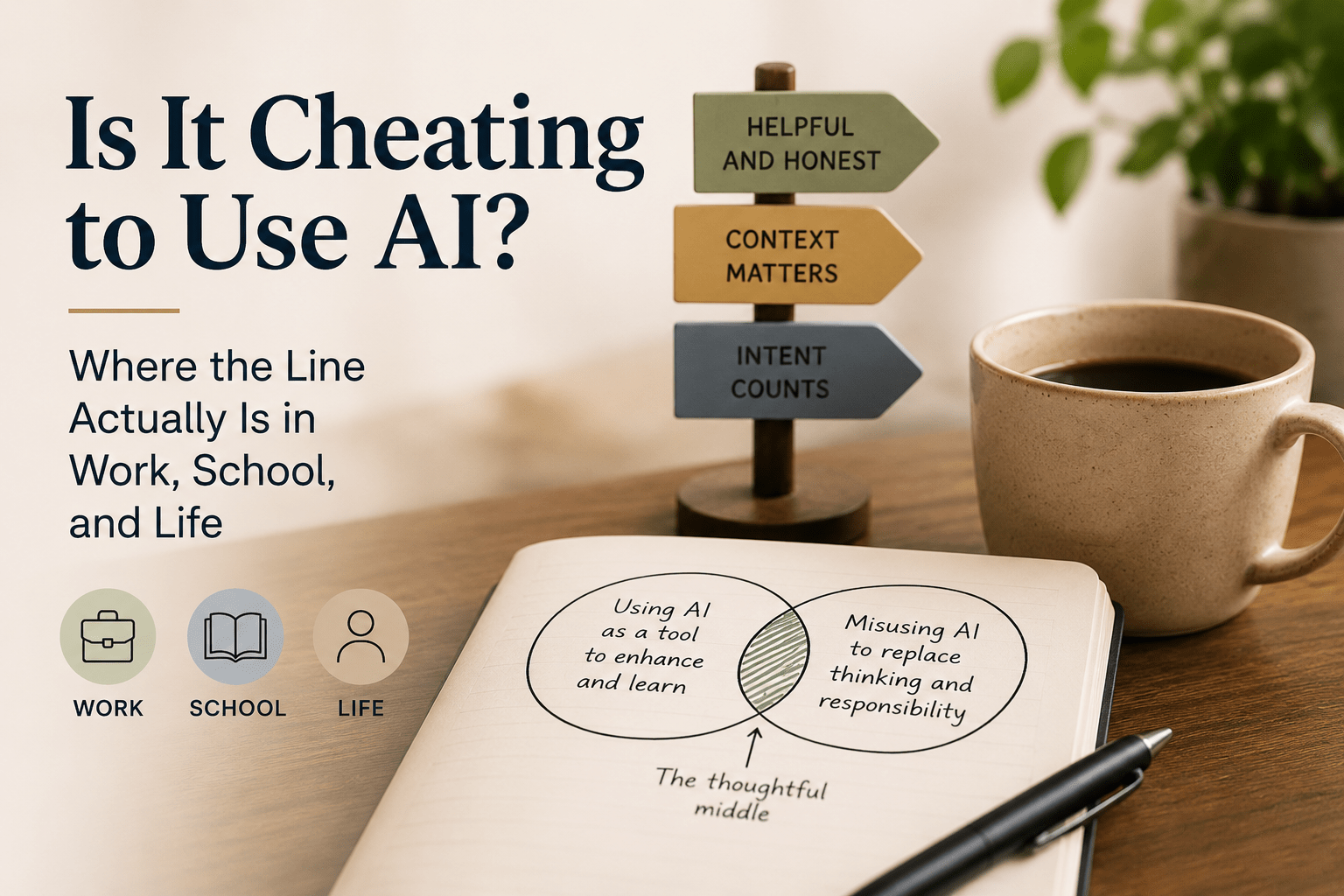
The question of whether it is cheating to use AI is one that genuinely reasonable people answer differently. It deserves a more careful treatment than the two most common responses, which are either “AI is just a tool like any other tool, using it is never cheating” or “using AI for any substantive task is dishonest.” Both of these answers fail on examination. The first ignores the genuine contexts where using AI is clearly deceptive. The second ignores the long history of tools that have extended human capability without anyone calling their use dishonest. This guide examines the question honestly and draws the line clearly. It gives you a framework for making your own judgments across the specific contexts where AI use comes up.
Why the Question “Is It Cheating to Use AI?” Does Not Have a Single Answer
The reason this question is genuinely difficult is that cheating is not a property of a tool — it is a property of a relationship between what was expected, what was promised, or what was agreed, and what was actually delivered. Using a calculator is not cheating in an accountant’s office. Using a calculator is cheating in a mental arithmetic examination. The calculator is the same in both cases. What differs is the context, the expectation, and the agreement.
AI is no different. Using AI to help draft a work email is not cheating. Nobody has agreed that your work emails must be unaided, and nobody is harmed by the email being better than you could have written alone. Using AI to write an essay that is submitted as your own unaided work under the explicit terms of an academic integrity policy is cheating — you have explicitly agreed not to do it, and the assessment is designed to evaluate your capability, which AI assistance undermines.
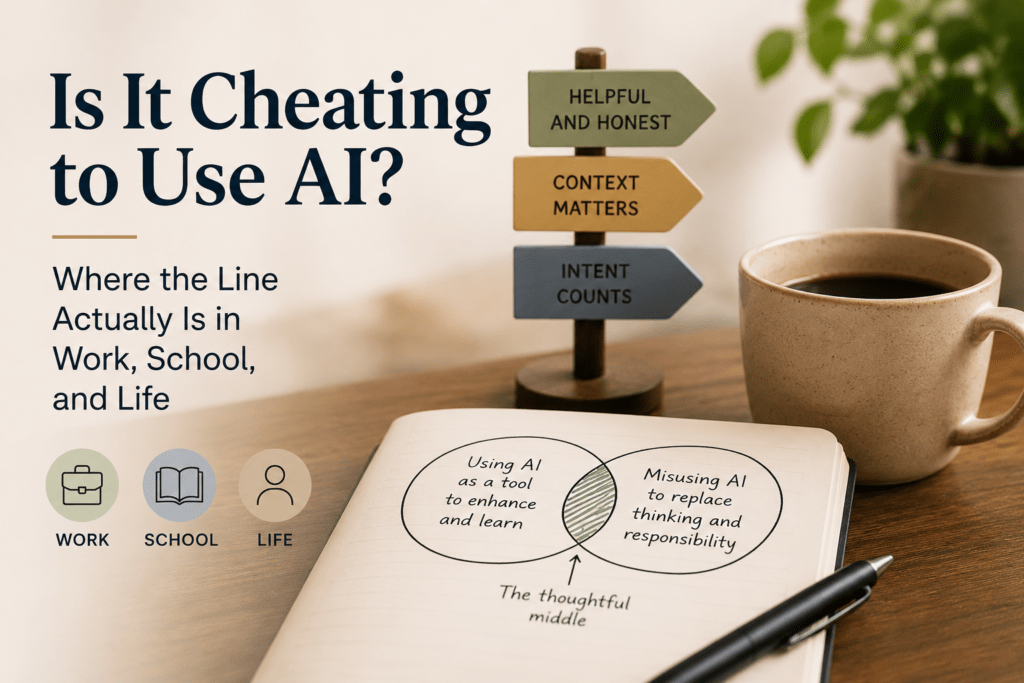
The line, therefore, is not “AI or no AI.” The line is: does using AI in this specific context breach an explicit or reasonable implicit agreement about what the work represents? With that framing, the question becomes answerable in most situations.
Is It Cheating to Use AI at School and University?
This is the context where the cheating question is sharpest, most frequently discussed, and most consequential in terms of the penalties for getting it wrong.
The clear cases are easy. Submitting an AI-written essay as your own work in a context where the assignment explicitly requires unaided work, and where the assessment is specifically designed to evaluate your writing capability, is academic dishonesty. This is true whether the policy explicitly prohibits AI or whether the prohibition is reasonably implicit in the nature of the assessment. The purpose of the essay is to demonstrate your learning and develop your thinking — submitting AI-generated work defeats both purposes and misrepresents your capability to the institution awarding your qualification.
At the same time, the assumption that all AI use in academic contexts is dishonest overreaches significantly. Using AI to explain a concept you are struggling to understand is no different from using Wikipedia or asking a tutor. It is a learning resource. Using AI to give feedback on a draft essay before you revise it yourself is not cheating any more than asking a friend to read your draft. Using AI to help you understand a source you are citing is not cheating.
The relevant question is: are you using AI to learn and develop your own capability, or are you using AI to produce work that misrepresents your capability? The former is legitimate study support. The latter is academic dishonesty.
A practical test for academic contexts: if you were asked to reproduce the submitted work under exam conditions without AI access, could you demonstrate the understanding it represents? If yes, AI use in producing it was legitimate support. If no — if the work represents capability you do not actually have — the AI use was dishonest.
Is It Cheating to Use AI at Work?
In most professional contexts, using AI is not cheating, and the concern that it might be reflects a misunderstanding of what professional work is for. Professionals are paid for outcomes — results, decisions, work product — not for the amount of manual effort those outcomes required. A lawyer who uses AI to research a question faster produces better legal advice faster. This helps them to serve the client better without deceiving them. A marketer who uses AI to produce a campaign brief in two hours rather than six produces a better brief in less time; the employer benefits.
The use of tools to produce better outcomes faster is not cheating in professional contexts — it is competence. Professionals have always used tools that extend their capability: reference books, calculators, spreadsheet software, research databases. AI is a more powerful version of the same principle.
However, there are specific professional contexts where AI use becomes problematic, and understanding these is important.
Contexts requiring professional certification or signature.
When a professional certifies, signs off on, or takes personal professional responsibility for work, that certification implies that the work reflects their professional judgment. A doctor who signs a clinical letter generated entirely by AI without applying their own clinical judgment is not simply using a tool — they are misrepresenting their professional involvement. A lawyer who submits AI-generated legal arguments without verifying them is not just using a tool efficiently — they are potentially misleading the court and their client. The professional responsibility that comes with professional certification requires the professional to genuinely engage with the content they are certifying.
Contexts where the client is paying specifically for your expertise.
If a client engages you specifically because of your personal expertise, experience, and judgment, and you deliver AI-generated work without any meaningful application of that expertise, you have misrepresented what they are buying. The question to ask is: am I using AI to help me deliver my expertise more effectively, or am I using AI to substitute for expertise I am claiming to provide?
Contexts with confidentiality obligations.
Pasting client information, confidential business data, or professionally privileged information into a consumer AI tool may breach professional confidentiality obligations regardless of whether the resulting work is good. This is not a cheating question but a professional conduct question, covered in more detail in our AI safety guide.
Is It Cheating to Use AI for Creative Work?
The creative context is the most philosophically interesting and the one where people’s intuitions vary most widely. Reasonable people genuinely disagree about whether AI-assisted creative work is authentic, and that disagreement deserves engagement rather than dismissal.
The case that AI-assisted creative work is not cheating rests on the observation that all creative work builds on what came before — the tools, influences, references, and collaborators that shape every creative product. A novelist who uses AI to suggest a plot resolution they then develop in their own voice is doing something structurally similar to asking a writing group for feedback or reading craft books for structural ideas. The AI is a collaborator and a tool; the creative judgment, the voice, and the meaning remain the human’s.
The case that it can become a problem rests on transparency and context. If you are submitting work to a creative competition that requires original unaided work, AI assistance without disclosure violates the competition’s terms. If you are selling creative work under the implicit or explicit premise that it represents your personal creative effort, AI-generated content without disclosure may be misrepresentation depending on the context and the buyer’s reasonable expectations.
The principle that resolves most creative AI questions is disclosure. In contexts where the authenticity or origin of the work matters — competitions, commissioned personal creative work, contexts where buyers are paying specifically for the human creative act — being transparent about AI’s role is the right approach. In contexts where the output is what matters — professional communication, content production, practical creative tasks — the tool used to produce the output is generally nobody else’s concern.
A Practical Framework for Deciding Whether AI Use Is Cheating
Rather than trying to memorise a set of rules, the following three questions resolve most practical AI ethics questions.
Question 1: Is there an explicit agreement or policy that prohibits or restricts AI use? If yes, follow it regardless of your personal view of whether it is a good policy. The academic integrity policy, the competition rules, the client contract — explicit agreements are binding regardless of whether you agree with them.
Question 2: Does using AI misrepresent your capability, expertise, or personal involvement in a way that matters to the person relying on that representation? If the answer is yes — your employer thinks you wrote something you didn’t, your institution thinks you have capability you don’t, your client thinks they are getting your expert judgment when they are getting AI output — the use is deceptive.
Question 3: Would you be comfortable disclosing your AI use to the relevant parties? This is the most practically useful test. If the honest answer is “no, I would not want them to know I used AI for this,” that discomfort is telling you something worth listening to.
If the answer to all three questions is negative — there is no explicit prohibition, you are not misrepresenting anything that matters, and you would be comfortable disclosing your AI use — then using AI for the task in question is not cheating by any reasonable definition.
Fully Worked Examples: Applying the Framework
Example 1
A student uses Claude to help them understand a difficult concept in economics, then writes their essay in their own words based on their understanding. The essay is submitted under standard academic integrity terms.
Assessment: Not cheating. The AI was used as a learning resource, not to produce the submitted work. The essay represents the student’s own understanding and capability.
Example 2
A marketing professional uses ChatGPT to produce a first draft of a campaign strategy, reviews it thoroughly, adds significant strategic thinking of their own, and presents it to a client as the agency’s work.
Assessment: Not cheating. The professional applied genuine expertise to the AI output, the client is paying for the outcome rather than the manual effort, and the work accurately represents the agency’s professional contribution.
Example 3
A student pastes an essay question into ChatGPT, submits the output with minor edits, under academic integrity terms that prohibit AI assistance.
Assessment: Cheating. The submitted work violates an explicit agreement, misrepresents the student’s capability, and would not survive disclosure.
Example 4
A freelance writer uses Claude to produce articles they sell to a content platform as original written work, without disclosure, where the platform’s terms specify original human-written content.
Assessment: Cheating. The work violates an explicit agreement and misrepresents the nature of what was delivered.
Example 5
A job applicant uses ChatGPT to help them write a stronger cover letter, submitting it as their application.
Assessment: Not cheating. Cover letters are a communication task — the job is won by the candidate’s qualifications and performance at interview, not by unaided cover letter writing ability. No reasonable employer considers cover letters a test of unaided writing capability.
For context on the broader range of considerations around honest and responsible AI use, our guide to AI myths covers the common misconceptions that lead people to either over-worry or under-worry about these questions. And for a practical grounding in the AI tools themselves, our beginner’s guide to AI is the right starting point for anyone who wants to explore what these tools can do before deciding how to use them.