The conversation about AI tends to focus on knowledge workers — office-based professionals whose jobs involve writing, analysis, and digital communication. This creates the impression that AI is not particularly relevant to tradespeople whose work is fundamentally physical and practical. In reality, AI for tradespeople is becoming one of the most practical time-saving applications available, and the trade professionals adopting these tools are gaining a competitive advantage in quoting, customer communication, administration, and marketing. This guide covers exactly what AI can do for plumbers, electricians, builders, and other trade professionals — in plain English, with no technical knowledge required.
The Real Time Problem for Tradespeople
The administrative burden on tradespeople is significantly underestimated by people outside the trades. In addition to the physical work itself, a typical self-employed tradesperson or small trade business handles customer enquiries, quote preparation, invoice generation, job scheduling, supplier communication, complaint management, and marketing — often at the end of a long physical working day when energy for writing and administration is at its lowest.
This administrative burden is where AI for tradespeople delivers the most immediate value. Not by replacing the skilled physical work — AI cannot fit a boiler, wire a consumer unit, or lay a foundation — but by handling the written, administrative, and communication tasks that surround that work far faster than doing them manually.
Writing Quotes and Estimates
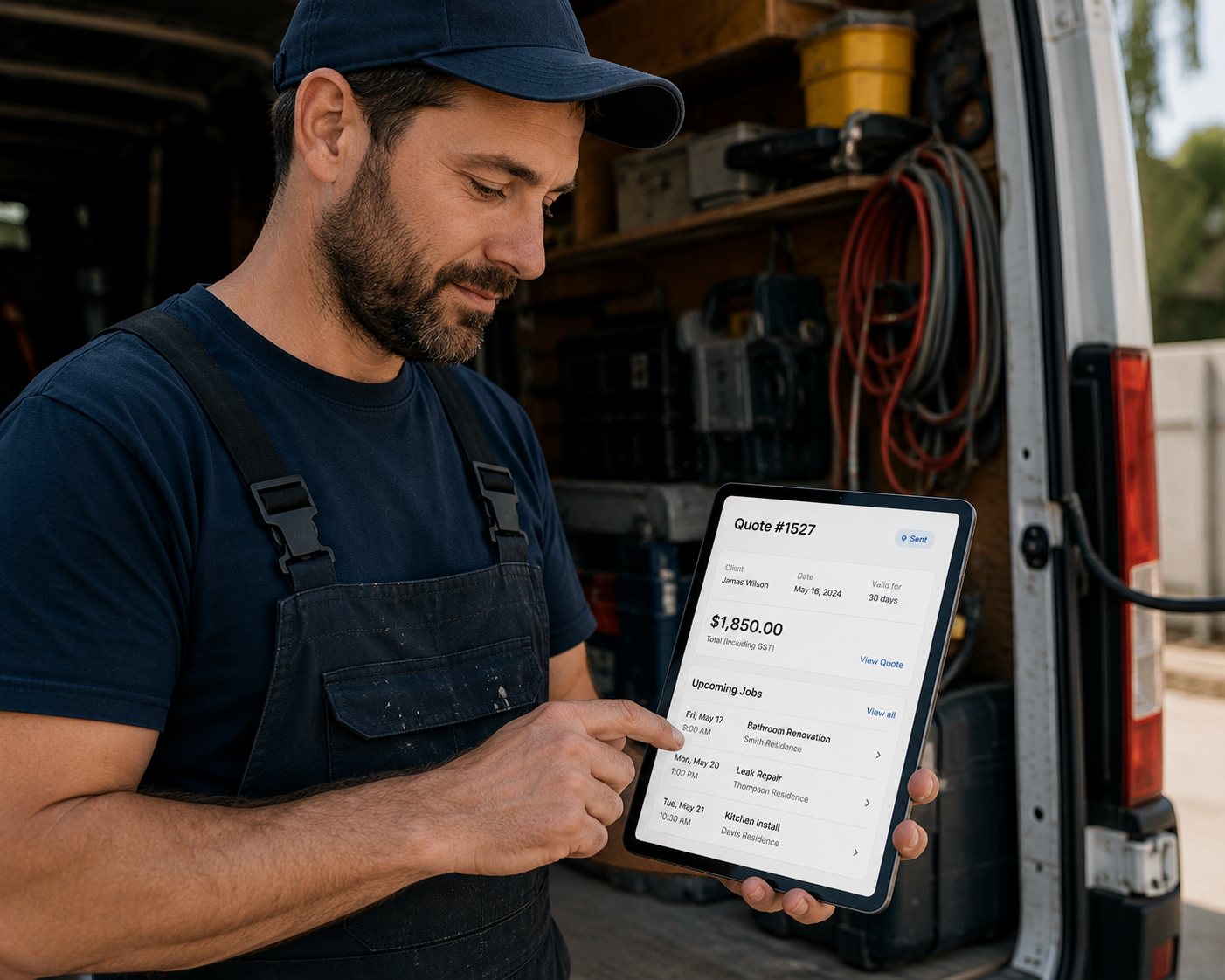
Preparing a professional, detailed quote is one of the most time-consuming administrative tasks for tradespeople, and one of the most important for winning work. A clear, professional quote communicates competence before the job starts. A rough or incomplete one raises doubts about the quality of the work to follow.
AI tools help tradespeople produce professional quotes quickly. The approach is to describe the job verbally — the work required, the materials needed, the estimated time, and any specific conditions or caveats — and ask Claude or ChatGPT to structure and format this into a professional written quote. The AI handles the formatting, the professional language, and the logical structure. The tradesperson provides the job-specific knowledge.
“Please help me write a professional quote for the following job: [describe the job, materials, and estimated cost]. The customer is [describe the customer]. Please format it as a clear, professional document that covers the scope of work, the price, the estimated timeline, and our payment terms.”
The resulting quote is more professional than most tradespeople produce manually, takes a fraction of the time, and gives customers the clear information they need to make a confident decision.
Responding to Customer Enquiries
Tradespeople receive enquiries at all hours — by text, email, and WhatsApp — often while on a job where sitting down to write a detailed response is not practical. The result is often delayed responses, which cost business to competitors who respond faster.
AI allows a tradesperson to respond to enquiries quickly and professionally without sitting down to compose a message from scratch. Dictate the key points of your response using your phone’s voice-to-text feature while on a break, paste the rough text into an AI tool, and ask it to produce a professional response. The whole process takes under two minutes and produces a response that would otherwise take ten to fifteen minutes of careful writing.
“Turn these rough notes into a professional response to a customer asking about [type of work]: [paste rough dictated notes].” The AI produces a clear, friendly, professional response that you review, adjust if needed, and send.
Writing Invoices and Following Up on Payment
Invoice preparation and payment chasing are consistent pain points for self-employed tradespeople. Late payment is endemic in the trades, and the communication required to chase it — professional, firm, but not confrontational — is genuinely difficult to write repeatedly.
AI handles invoice formatting and payment chasing communication straightforwardly. For invoices, provide the job details, the amount, and your payment terms, and ask for a professional invoice formatted for your business. For payment chasers, describe the situation — the invoice amount, the due date, how overdue it is, and the desired outcome — and ask for a professional, firm reminder.
As our guide to using AI for emails discusses, AI is particularly useful for difficult communications that are emotionally charged or that you find yourself repeatedly putting off. Payment chasing sits squarely in this category.
Writing Reviews Responses
For tradespeople using platforms like Checkatrade, Trustatrader, or Google Business, online reviews are a primary driver of new enquiries. Responding to reviews professionally — and particularly to negative ones without becoming defensive — has a direct impact on how potential customers perceive the business.
AI tools produce professional, personalised review responses quickly, as detailed in our review response guide. For tradespeople who find writing difficult or time-consuming, this removes one of the most consistent barriers to maintaining an active, professional online presence.
Marketing Without a Marketing Budget
Most self-employed tradespeople have no marketing budget and no marketing expertise. Word of mouth has traditionally been the primary driver of trade business — and while it remains important, an active online presence increasingly supports and amplifies it.
AI tools make basic marketing activity realistic for tradespeople who have neither the time nor the skill to produce marketing content manually. A monthly session with ChatGPT can produce a month’s worth of Facebook posts, Google Business updates, or local community group content — before-and-after project descriptions, seasonal tips relevant to your trade, brief explanations of services. The content demonstrates expertise, keeps the business visible in local searches, and builds a body of online content without requiring significant writing skill or time.
Practical First Steps for Tradespeople
The best starting point for a tradesperson new to AI tools is the task that currently takes the most time relative to its importance. For most tradespeople, that is either quote writing or customer communication.
Start by using ChatGPT or Claude to help write your next quote. Describe the job, paste in the rough details, and ask for a professional formatted document. Compare the result to what you would have written manually. For most tradespeople, the quality difference is immediately apparent, and the time saving — from thirty minutes of writing to five minutes of reviewing — is compelling enough to make AI a permanent part of the quote process.
Our beginner’s guide to AI covers the practical first steps of setting up a free account and having a first productive session, with no technical knowledge required. The tools that benefit office workers are exactly the same ones that benefit tradespeople — the applications are simply different.