Most small business owners know they need a marketing plan. Very few actually have one. The gap between knowing and doing usually comes down to three barriers: not knowing where to start, not having the time to do it properly, and not feeling confident enough in marketing knowledge to produce something useful. Learning how to use AI to create a marketing plan removes all three barriers simultaneously. This guide walks through the entire process — from understanding your business and audience to producing a practical, actionable marketing plan — using AI as your guide throughout.
Why Most Small Business Marketing Plans Fail
Before building a marketing plan, it helps to understand why most small business marketing plans either don’t get made or don’t get used. The most common failure mode is complexity — a plan that is too elaborate, too expensive to execute, or too time-consuming to maintain alongside actually running the business.
A useful marketing plan for a small business is not a forty-page strategic document. It is a clear, concise description of who you are trying to reach, what you want to say to them, which channels you will use to say it, how often you will show up, and how you will know if it is working. AI is excellent at helping you produce exactly this — a practical, realistic plan that you can actually execute with the resources available to you.
How To Use AI To Create A Marketing Plan – Step 1: Define Your Business and Audience With AI’s Help
The foundation of any marketing plan is clarity about what you’re selling and who you’re selling it to. Many small business owners have an intuitive sense of this but struggle to articulate it precisely. AI helps by asking the right questions and turning your answers into clear statements.
Start with this prompt: “I run a small business and I want to create a marketing plan. Before we build the plan, please ask me the five most important questions about my business and target customers that you need answered to produce a useful marketing plan.”
The AI will typically ask about your product or service, your target customer, your competitors, your current marketing activity, and your goals. Answer each question as honestly and specifically as you can. The more specific your answers, the more targeted the resulting plan. Once you’ve answered, ask the AI to summarise what it’s learned: “Based on my answers, please write a brief description of my business, my target customer, and my main competitive advantage.”
Review this summary carefully. If anything is off, correct it before moving on. This summary becomes the foundation that the rest of the plan is built on.
How To Use AI To Create A Marketing Plan – Step 2: Identify Your Marketing Goals
A marketing plan without clear goals is a list of activities rather than a strategy. Before generating the plan itself, use AI to help you define what success looks like for your business.
Effective marketing goals are specific and measurable. “Get more customers” is not a goal — it is an aspiration. “Acquire twenty new customers in the next three months” is a goal. “Increase repeat purchase rate from 15% to 25% over six months” is a goal. AI helps you move from aspiration to specificity with a targeted prompt.
“Based on the business description we’ve built, help me define three specific, measurable marketing goals for the next six months. Ask me any questions you need to make these goals realistic given my resources and stage of business.”
The AI produces three concrete goals tailored to your situation, with a short explanation of why each one matters. Adjust them based on your knowledge of your business, and confirm them before moving to the next step.
How To Use AI To Create A Marketing Plan – Step 3: Choose Your Marketing Channels
One of the most common small business marketing mistakes is spreading effort across too many channels simultaneously and doing none of them well. AI helps you identify the two or three channels most likely to reach your specific target customer effectively.
“Given my target customer description and business type, which two or three marketing channels are most likely to reach them effectively? Please explain the reasoning for each recommendation and flag any channels I should avoid based on my situation.”
The AI’s recommendations will depend on what you’ve told it about your business and customer. A local bakery targeting neighbourhood families will get different channel recommendations from a freelance graphic designer targeting marketing agencies — which is exactly the point. The plan needs to fit your specific situation.
For each recommended channel, ask a follow-up question: “For [channel], what specifically should I be posting or doing, how often, and what does good look like for a business at my stage?” This produces channel-specific guidance that is immediately actionable.
How To Use AI To Create A Marketing Plan – Step 4: Build a Content and Activity Plan
With your channels identified, the next step is creating a content and activity plan — a practical schedule of what you will produce, when, and for which channel. This is where many marketing plans become unrealistic, so the prompt you use here should explicitly account for your capacity constraints.
“Please create a realistic monthly marketing activity plan for my business based on the channels we’ve identified. I have approximately [X hours] per week to spend on marketing. Please make sure the plan is achievable within that time constraint and does not assume any marketing team or budget beyond [your budget].”
The AI produces a monthly plan that fits your actual capacity — a Monday LinkedIn post, a fortnightly email newsletter, a weekly Instagram story — rather than an aspirational plan that requires resources you don’t have. Review the plan against your calendar and adjust anything that conflicts with your known commitments.
How To Use AI To Create A Marketing Plan – Step 5: Write a One-Page Marketing Plan
With all the elements in place, ask AI to compile everything into a clean, one-page marketing plan document you can refer to regularly.
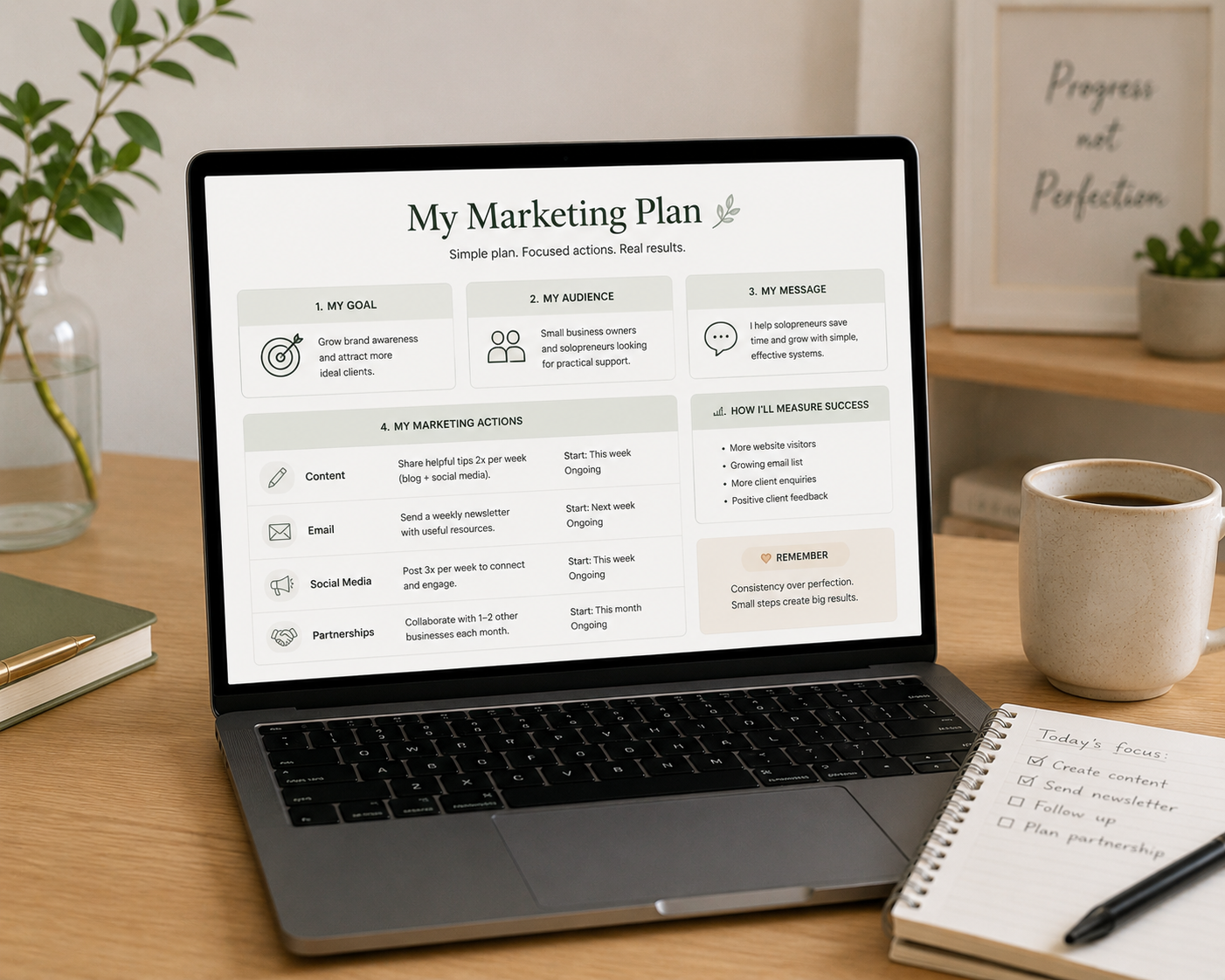
“Based on everything we’ve discussed — my business description, my target customer, my goals, my channels, and my activity plan — please write a clean, one-page marketing plan I can use as a reference document. Include sections for: Business Summary, Target Customer, Marketing Goals, Channels and Rationale, Monthly Activity Plan, and How I’ll Measure Success.”
The resulting document gives you a single reference point that keeps your marketing activity aligned with your goals. Print it out, pin it up, and refer to it whenever you’re deciding how to spend your marketing time.
Measuring Whether It’s Working
A marketing plan is only useful if you review it regularly and adjust based on what’s working. AI assists with this review process too. At the end of each month, share a brief summary of what you did and what you observed — engagement on posts, new enquiries, website visits, sales — and ask for an interpretation.
“Here is what I did for marketing this month and the results I observed: [summary]. Based on this, what seems to be working, what isn’t, and what should I adjust in next month’s plan?”
This monthly review loop — plan, execute, review, adjust — is how effective marketing is actually built over time. AI makes the planning and review steps fast enough that they don’t consume disproportionate time relative to the actual marketing activity, which is where the real effort should go. Our guide on how small business owners use AI covers additional marketing applications in the broader context of AI-assisted business operations.