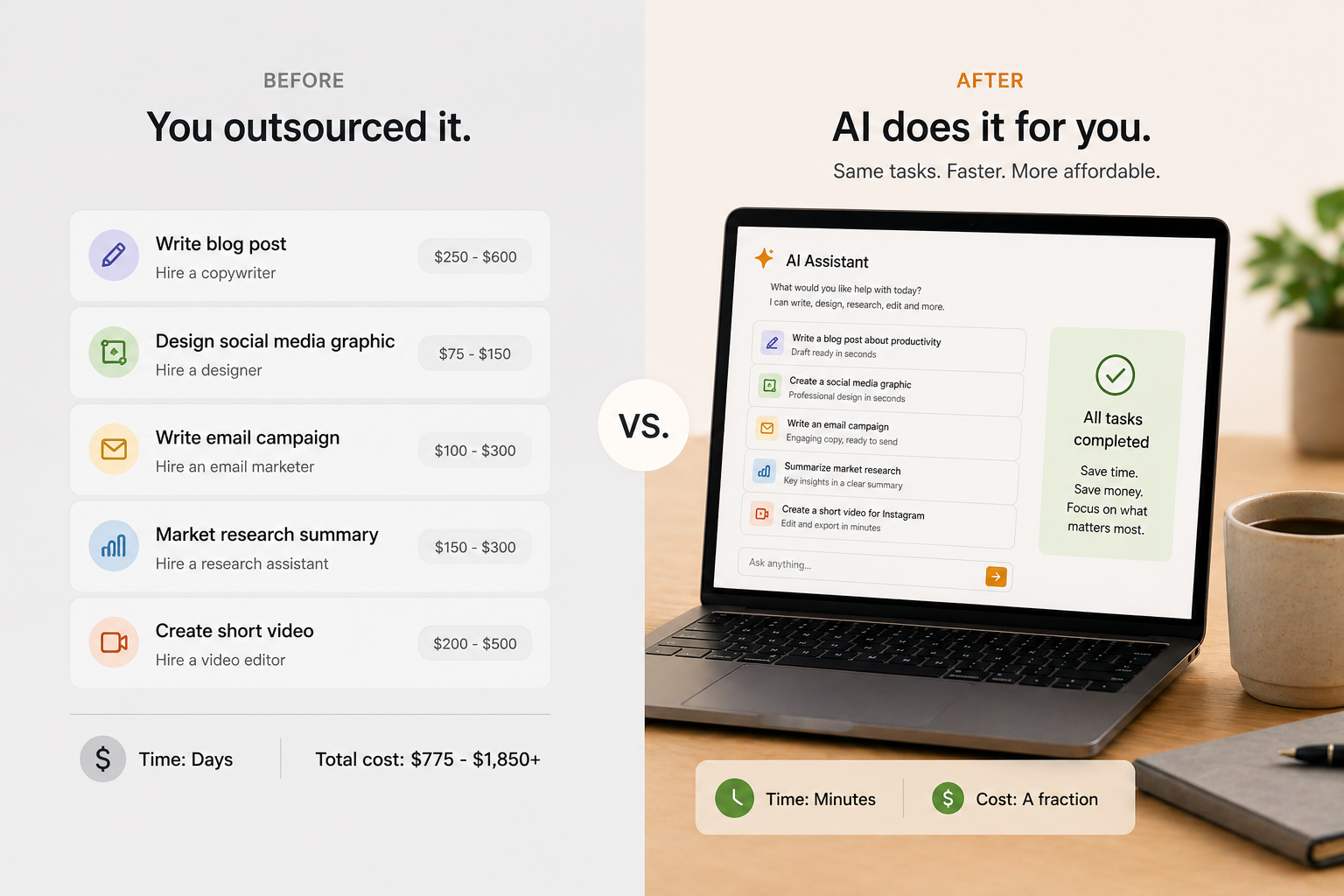
One of the most significant practical effects of AI tools in 2026 is that they have made a range of tasks accessible to individuals and small businesses that previously required hiring a professional or outsourcing to a specialist. AI tools that replace outsourced tasks are not hypothetical — they are available today, most have free tiers, and many individuals and small business owners are already using them to reduce costs without reducing quality. This guide covers the most valuable categories, which tools to use, and the realistic limitations of each.
Graphic Design: Canva AI and Midjourney
Professional graphic design has historically required either hiring a designer — typically at rates of £50 to £150 per hour — or spending significant time learning tools like Adobe Illustrator or Photoshop. For small businesses, solopreneurs, and individuals who need professional-looking visual content occasionally, neither option is ideal.
Canva AI has made competent graphic design accessible to non-designers. Its AI features generate complete design layouts from text descriptions, suggest design elements, resize content automatically for different platforms, and produce professional-looking results without any design knowledge. For social media graphics, presentation slides, flyers, and basic marketing materials, Canva AI produces results that would previously have required a designer.
Midjourney and DALL-E (available through ChatGPT) extend this capability to custom image generation — creating original visual assets from text descriptions rather than selecting from templates. For businesses that need distinctive visual content — custom illustrations, unique product mockups, original brand imagery — these tools offer a level of creative flexibility that stock photography and template-based design cannot match.
Realistic limitation: For complex branding work, multi-element print design, or anything requiring precise technical specifications, a professional designer still adds value that AI cannot replicate. AI graphic design tools are most effective for straightforward, recurring visual content needs rather than for foundational brand work.
Copywriting and Content: Claude and ChatGPT
Professional copywriting — for websites, advertisements, email campaigns, product descriptions, and marketing materials — commands significant fees from experienced practitioners. AI tools for content creation have narrowed the gap between professional and amateur output considerably, though they haven’t eliminated it.
For product descriptions, social media posts, email subject lines, blog outlines, and standard marketing copy, Claude and ChatGPT produce competent first drafts that require editing rather than complete rewriting. A small business owner who previously paid a copywriter for product descriptions can now produce comparable quality with AI assistance and a review pass.
As our guide to writing better AI prompts explains, the quality of AI content output is directly proportional to the quality of the instructions you give it. Vague prompts produce generic output. Specific prompts — with clear audience definition, tone requirements, and examples of the style you want — produce output that requires minimal editing and is genuinely fit for purpose.
Realistic limitation: For high-stakes copy — a major advertising campaign, a comprehensive website rewrite, a brand narrative — experienced copywriters bring strategic insight and creative judgment that AI tools do not replicate. AI is most valuable for volume copy and iterative content, less so for foundational creative strategy.
Basic Legal Documents: Claude with Professional Review
Standard legal documents — non-disclosure agreements, basic service contracts, freelance agreements, privacy policies, and terms and conditions — follow recognisable structures that AI handles surprisingly well. Claude can produce serviceable first drafts of these documents from a clear description of the terms you want to include.
This does not mean AI replaces legal advice. As discussed in our realistic guide to AI capabilities, AI cannot advise you on the legal implications of specific clauses, the enforceability of particular terms in your jurisdiction, or the strategic considerations that experienced lawyers bring to contract negotiation. What it can do is produce a first draft that a lawyer can review and refine, significantly reducing the billable hours required for straightforward documents.
For individuals and small businesses that need basic, standard agreements and cannot justify £300 per hour legal fees for routine documentation, this represents a meaningful practical saving — provided the AI draft is reviewed by a qualified solicitor before use.
Realistic limitation: Anything beyond standard templates — complex commercial contracts, employment disputes, intellectual property matters, or any document with significant legal consequences — requires qualified legal advice. AI is a starting point, not a substitute.
Basic Bookkeeping and Financial Organisation: ChatGPT and Claude
Basic bookkeeping tasks — categorising expenses, producing simple income and expenditure summaries, creating invoice templates, and maintaining basic financial records — have historically required either a bookkeeper or significant personal time. For small businesses and sole traders with straightforward finances, AI tools now handle a meaningful portion of this work.
You can paste raw transaction data into Claude or ChatGPT and ask it to categorise expenses, identify tax-deductible items, and produce a formatted monthly summary. You can ask it to create professional invoice templates, set up a simple expense tracking system, and explain what records you need to keep for tax purposes.
This builds naturally on the budgeting approach covered in our guide to building a personal budget with AI. The same conversational approach that works for personal finances applies to basic business financial organisation.
Realistic limitation: AI cannot file your tax return, advise you on allowable expenses specific to your business type, or handle complex accounting scenarios. For anything beyond basic organisation and record-keeping, an accountant remains essential. The value AI adds is in reducing the administrative burden before the accountant gets involved — meaning less billable time spent on organisation, more on actual advice.
Translation: DeepL and ChatGPT
Professional translation services charge per word and per language pair, with costs that add up quickly for businesses operating across multiple languages. AI translation tools have improved dramatically in recent years and now produce output that is indistinguishable from professional translation for many everyday business communication needs.
DeepL remains the gold standard for AI translation quality — its output is more natural and idiomatic than Google Translate and most other general-purpose AI tools for straightforward document translation. ChatGPT and Claude offer more flexibility for translation tasks that require tone adjustment or cultural adaptation alongside the language switch.
For internal communications, product descriptions, customer-facing emails, and routine business documents, AI translation delivers quality that would previously have required a human translator. For legal documents, marketing materials where cultural nuance is critical, or any content where errors carry significant consequences, professional human translators still provide a level of reliability and accountability that AI tools cannot match.
Transcription: Otter.ai and Whisper
Audio and video transcription — converting recorded speech to text — was previously a time-consuming manual task or an expensive outsourced service. AI transcription tools now handle this faster than real-time and at a fraction of the previous cost.
Otter.ai produces accurate transcriptions of meetings, interviews, and recorded audio, as covered in our guide to AI meeting notes. OpenAI’s Whisper — available through various tools and apps — handles a wide range of accents and audio quality levels with impressive accuracy. For podcasters, researchers, journalists, and businesses that regularly work with recorded audio, these tools have effectively replaced the transcription outsourcing market for standard use cases.
The Honest Assessment
AI tools that replace outsourced tasks are not replacements for professional expertise in complex, high-stakes, or strategically important work. They are, however, genuinely capable substitutes for the routine, standard, and repetitive portions of professional services that individuals and small businesses have historically outsourced at significant cost.
The practical approach is to identify which outsourced tasks in your life or business are routine and formulaic — and therefore well-suited to AI — and which require genuine expertise and judgment. Use AI for the former, professionals for the latter. The result is a meaningful reduction in outsourcing costs without a meaningful reduction in quality or outcomes.