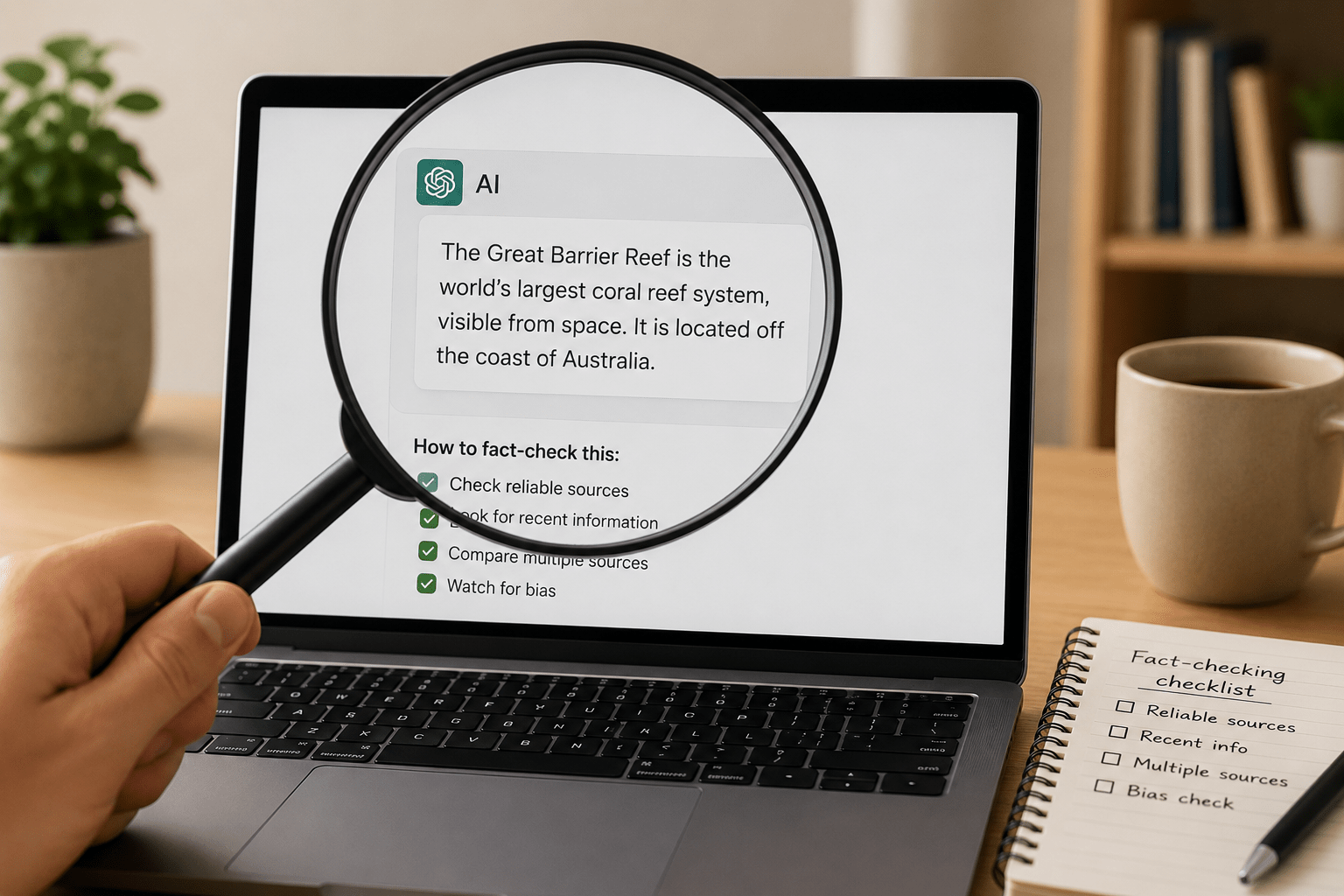
Every person who uses AI tools regularly eventually has the experience of nearly using something that turned out to be wrong. A statistic that sounded authoritative but couldn’t be traced to any real source. A name that turned out to be a composite of two different people. A legal requirement that had actually changed eighteen months ago. A study that, on closer inspection, did not appear to exist. Knowing how to fact-check AI output is not optional for anyone who uses these tools for anything that matters — and the good news is that it does not require specialist skills, expensive subscriptions, or hours of research. This guide covers exactly how to fact-check AI, which specific types of output require the most scrutiny, the free tools that make verification fast, and a series of fully worked real-world examples that show the process from start to finish.
Why Fact-Checking AI Is Different From Fact-Checking a Human
When a human expert gives you information, there are built-in signals that tell you how confident they are. For example, they hedge when they are uncertain. They say “I think” or “I’m not entirely sure” when they are working from memory. They refer you to a source when they want you to verify something. Their hesitation, their qualifications, and their body language all communicate the reliability of what they are telling you alongside the content itself.
AI has none of these signals. It delivers correct information and hallucinated information in exactly the same fluent, confident tone. There is no hesitation about uncertain facts. There is no “I think” before a fabricated statistic. The confident presentation of AI output is not a measure of its accuracy. It is simply how AI outputs are structured, regardless of whether the underlying content is reliable.
This is why learning how to fact-check AI requires a different approach from evaluating human sources. With humans, you calibrate trust based on expertise, track record, and the signals of confidence or uncertainty. With AI, you calibrate trust based on the type of claim. You must understand that some categories of AI output are reliably accurate and others require systematic verification, regardless of how confident the AI sounds.
Furthermore, fact-checking AI output is not about distrust. It is about appropriate calibration. Most AI output, most of the time, is accurate enough for the task at hand. The skill of fact-checking AI is knowing which specific claims in which specific contexts require verification. This is better than either verifying everything (impractical) or verifying nothing (dangerous).
The Three Categories of AI Output and Their Verification Needs
The most efficient approach to fact-checking AI divides its output into three categories based on how much verification each requires.
Category 1: Low verification risk. General explanations of established concepts, writing assistance and drafting, brainstorming and ideation, summarisation of content you can check against the original, and structural or organisational help all carry low verification risk. The AI is either helping you think or generate language rather than asserting specific facts, or it is working from content you provided rather than generating facts from its training data. For this category, a quick read-through for coherence and accuracy is sufficient.
Category 2: Moderate verification risk. General factual claims about topics where the answer is unlikely to have changed recently carry moderate risk. This may include how a biological process works, the historical sequence of well-documented events, and the general principles of an established field. These claims are usually accurate but occasionally wrong, particularly at the level of specific details. Spot-checking the most specific or surprising claims against a reliable source is the appropriate level of scrutiny.
Category 3: High verification risk. Specific statistics and numerical data. Named citations, research studies, and academic references. Legal and regulatory requirements. Medical specifics including drug names, dosages, and treatment protocols. Current events and recent developments. Financial regulations and requirements. Names, dates, and biographical details of individuals. Any claim that includes a specific number, a specific name, or a specific date falls into this category. It requires verification against a primary source before use in any professional or consequential context.
How to Fact-Check AI: The Core Techniques
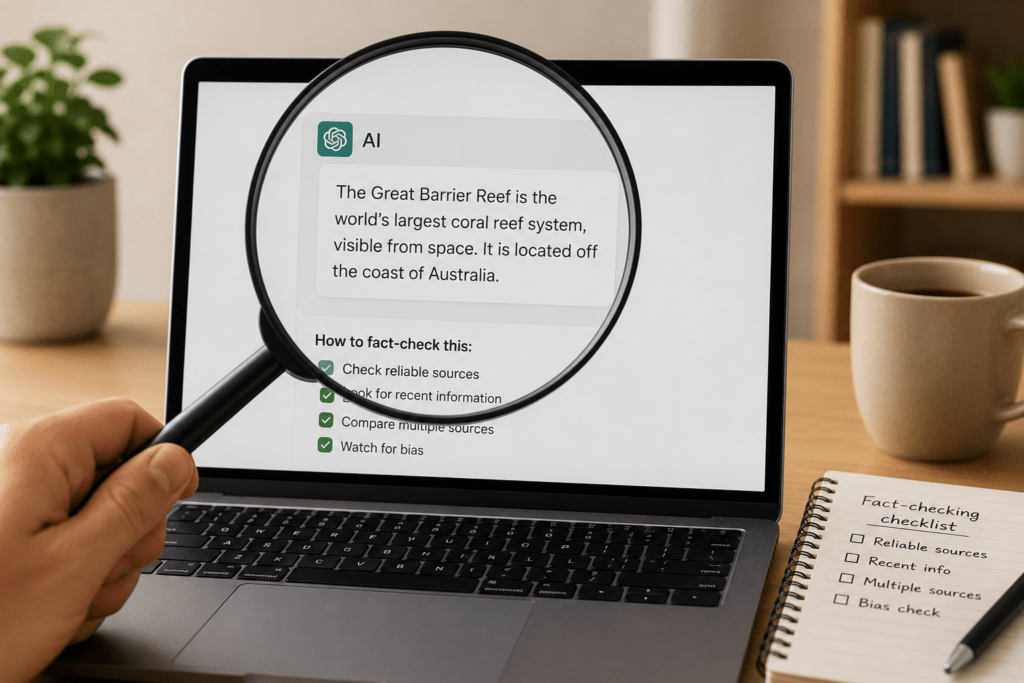
Technique 1: The primary source search. When AI produces a specific statistic, finding the original source is the most reliable verification method. Take the specific claim — “according to a 2024 study by the University of Michigan, 67% of employees reported reduced productivity after AI implementation” — and search for the original study. If the study does not exist, if the university did not conduct it, or if the statistic is different in the original, you have confirmed a hallucination. Use Google Scholar, the institution’s website, or a relevant industry database for this search.
Technique 2: The Perplexity cross-check. Perplexity is the most useful free tool for cross-checking AI factual claims because it searches the web in real time and shows its sources. Take the specific claim from Claude or ChatGPT and ask Perplexity the same question. Compare the answers. If Perplexity produces a different answer or cannot find evidence for the specific claim, that is a strong signal requiring further investigation. If Perplexity produces the same answer with credible source links, the claim is considerably more reliable.
Technique 3: The AI self-audit. Ask the AI to assess its own confidence in specific claims within its response. “In the response you just gave me, which specific facts or statistics are you most uncertain about? Which claims are based on specific sources you can name, and which are based on general training data that may not be fully accurate?” This technique does not eliminate errors — AI self-assessment is imperfect — but it often causes the AI to qualify claims it presented confidently, giving you a useful indicator of where to focus verification effort.
Technique 4: The official source check. For legal requirements, regulatory information, medical guidance, tax rules, and any topic governed by official bodies, always verify against the official source. These sources may include government websites, regulatory authority publications, and professional body guidelines. They are authoritative, current, and free. AI summaries of legal and regulatory requirements are useful starting points, but the official source is the verification endpoint.
Technique 5: The date check. For any claim about current practice, current law, current pricing, or current statistics, check when the AI’s information is from. Ask directly: “When is this information from and is there a risk it has changed since your training cutoff?” If the answer could be affected by recent changes, use a current source — Perplexity, a relevant government or regulatory website, or a recent news source — to verify currency.
Fully Worked Real-World Example 1: Fact-Checking an AI Medical Claim
Scenario: You ask Claude: “What is the recommended daily amount of vitamin D for adults over 65 in the UK?”
AI response: “The NHS recommends that adults over 65 take 10 micrograms (400 IU) of vitamin D daily, particularly during autumn and winter months when sunlight exposure is insufficient. Some guidance suggests that people at higher risk of deficiency may benefit from higher doses, and the safe upper limit is generally considered to be 100 micrograms (4,000 IU) per day.”
Why this requires verification: This is a specific medical recommendation from a named official body (the NHS). Medical guidance changes. The numbers could be outdated.
Verification process: Go to nhs.uk and search “vitamin D supplements.” The NHS page on vitamin D confirms the 10 microgram recommendation for adults and specifically mentions the over-65 recommendation. The safe upper limit figure can be cross-checked against the NHS page on vitamin D safety.
Outcome: In this case, the AI response is accurate and consistent with current NHS guidance. However, the verification process is what establishes that — not the AI’s confidence.
What to do if the verification had failed: If the NHS website had shown a different recommendation — say, updated guidance now recommending 15 micrograms — you would use the official source rather than the AI’s outdated figure and note that the AI’s information was out of date.
Fully Worked Real-World Example 2: Fact-Checking an AI Statistical Claim
Scenario: You are writing a blog post and ask ChatGPT for statistics on remote working adoption. ChatGPT responds: “According to a 2024 McKinsey Global Institute report, 58% of workers in advanced economies have the opportunity to work remotely at least part of the time, and companies that adopted hybrid working saw productivity increases of 22% on average.”
Why this requires verification: Two specific statistics, attributed to a named source. Statistics with precise numbers and named sources are prime hallucination territory.
Verification process: Go to mckinsey.com and search for the specific report. Search Google Scholar for the McKinsey statistic. Search Perplexity for “McKinsey 2024 remote work statistics.”
Outcome: The 58% figure originates from a real McKinsey report, but it is from 2021, not 2024. The AI generated an incorrect date. The 22% productivity figure does not appear in McKinsey research at all. It is a hallucinated statistic that sounds plausible but has no traceable source.
What to use instead: The genuine McKinsey statistic from the correctly dated report, cited accurately. The 22% productivity claim should be dropped entirely or replaced with a verifiable statistic from a real source found through Perplexity or Google Scholar.
Fully Worked Real-World Example 3: Fact-Checking an AI Legal Claim
Scenario: You are a small business owner and ask Claude: “What are the rules around providing payslips to employees in the UK?”
AI response: “Under UK law, employers are legally required to provide a written payslip to all employees on or before their payday. The payslip must show gross pay, any deductions and their reasons, and net pay. Failure to provide a payslip is a breach of the Employment Rights Act 1996.”
Why this requires verification: Specific legal requirement, specific legislation cited. Legal requirements change. Jurisdiction-specific rules are a hallucination risk.
Verification process: Go to gov.uk and search “payslips employees.” The UK government website confirms the legal requirement, the content requirements, and the legislation. Cross-check whether the legislation name is accurate.
Outcome: The AI response is broadly accurate. The Employment Rights Act 1996 is correctly cited. However, since 2019, the right to pay slips has been extended to workers as well as employees. This is a distinction the AI response did not mention. The official source reveals the gap in the AI’s answer.
Practical implication: The AI gave a correct but incomplete answer. The official source provided the complete, current picture. This is a common pattern. AI accuracy is often directionally correct but missing recent updates or nuances that only current official sources reveal.
Building a Sustainable Fact-Checking Habit
The goal is not to verify every word of every AI response — that would eliminate the efficiency gains that make AI useful. The goal is a calibrated habit that protects you from the specific errors that have real consequences while allowing you to use AI freely for the vast majority of tasks where the verification overhead is not justified.
A practical rule of thumb: if you are about to share, publish, submit, or act on a specific AI-generated claim — particularly one that includes a number, a name, a legal requirement, or a current fact — spend ninety seconds verifying it against a primary source before you do. Ninety seconds of verification protects you from errors that could take hours to correct after the fact.
For regular AI users, building the habit of opening Perplexity in a separate tab during any research-oriented AI session provides ongoing cross-checking with minimal friction. The combination of a generative AI tool for drafting and synthesis and Perplexity for real-time fact verification is one of the most reliable research workflows available to non-technical users today.
Our guide to AI mistakes and limitations covers the underlying reasons why AI errors occur, which provides useful context for understanding why certain types of claims require more scrutiny than others. For guidance on using Perplexity specifically as a research and verification tool, our free AI tools guide covers its capabilities and how to access it without any setup.