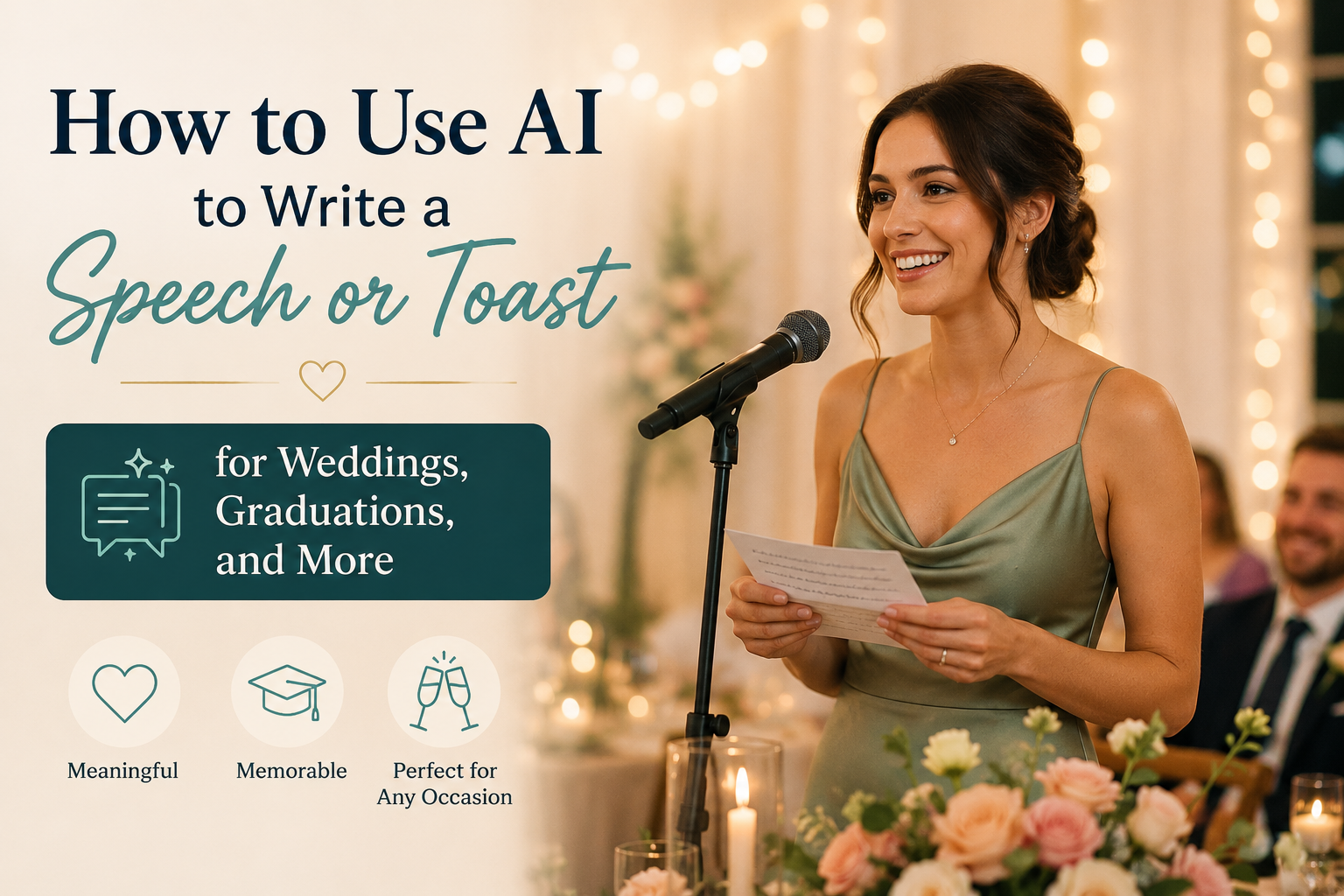
The request to give a speech — at a wedding, a graduation, a retirement party, or any significant occasion — produces a particular kind of anxiety in most people. It combines the difficulty of writing with the vulnerability of public speaking, and it adds the pressure of doing justice to someone you care about in front of everyone they care about. Learning how to use AI to write a speech does not eliminate that pressure, but it does remove the most significant practical obstacle: the blank page. This guide covers exactly how to work with AI to produce a speech that sounds genuinely like you, captures the person you’re speaking about accurately, and lands well with the audience.
Why AI Is Particularly Useful for Speech Writing
Speech writing presents a specific challenge that general writing does not: the speech needs to sound like you, not like a generic speech. An AI-generated speech that reads like a template — polished but impersonal — is worse than a rough but genuine personal effort, because audiences respond to authenticity above all else.
The key to using AI for speech writing effectively is understanding that AI’s role is structural and linguistic rather than substantive. You provide the content — the memories, the personal observations, the specific details that only you know — and AI provides the structure, the transitions, the pacing, and the language that makes those details land effectively. The speech that results reflects your relationship with the person, not a generic template relationship. As pointed out in our post on what AI can realistically do, it cannot do everything.
Step 1: Gather Your Material Before Prompting
Before opening your AI tool, spend twenty minutes writing down everything you want to include — unstructured, in any order, without worrying about how it sounds. This is your raw material, and the quality of this step determines the quality of the final speech more than anything else.
Include specific memories and anecdotes — concrete, particular moments rather than general observations. Include genuine observations about the person — their character, their approach to life, their relationship with others. Also, include the feelings you want to convey — gratitude, affection, pride, humour. Finally, include anything you’ve been wanting to say that you haven’t had the right moment to say.
Don’t edit yourself at this stage. Write down everything, including things you’re not sure you’ll use. The AI can help you decide what to include and what to leave out — but only if it has the material to work with.
Step 2: Set Up the AI Conversation
Open Claude — which handles personal, emotional writing tasks with particular sensitivity — and begin with a prompt that establishes the context fully before asking for a draft.
“I need to write a [type of speech — best man speech, maid of honour speech, father of the bride speech, graduation toast, retirement speech] for [occasion] for [person’s name]. Before I ask you to draft anything, here is my raw material — my memories, observations, and what I want to say: [paste your raw notes]. Please read through this and ask me any questions that would help you understand the person better or the relationship we have, before we start drafting.”
This approach — sharing raw material and inviting questions before asking for a draft — produces a significantly more personal and accurate result than going straight to a draft request. The AI’s follow-up questions often surface additional details you hadn’t thought to include.
Step 3: Request the First Draft
Once you’ve answered the AI’s questions, ask for a first draft with specific structural instructions.
“Please draft a [length — two minute / five minute] speech based on my material and our conversation. The tone should be [warm and heartfelt / warm with some humour / primarily funny with sincere closing]. Please structure it with a strong opening that gets the audience’s attention, a middle section that covers [two or three key themes from your material], and a closing that [describes what you want the ending to achieve — brings people back to the occasion, ends on a sincere note, lands a final joke]. Please write it in first-person language that sounds natural when spoken aloud rather than read.”
The instruction to write for spoken delivery is important. AI naturally defaults to written language, which sounds stilted when read aloud. Specifying spoken language produces shorter sentences, natural contractions, and a rhythm that works better when delivered at a microphone.
Step 4: Make It Sound Like You
The first draft will be structurally sound but may not yet sound like you. This is where the real personalisation happens. Read the draft aloud — literally say the words out loud — and identify anywhere that feels unnatural or out of character.
Return to the AI with specific feedback: “This section sounds too formal for how I actually speak. Can you rewrite it in a more casual tone?” or “I wouldn’t use the word ‘profoundly’ — can you find something simpler?” or “This transition feels abrupt — can you smooth it?” or “I’d like to add this specific memory here: [describe it]. Can you work it in?”
Repeat this process — read, identify what feels off, give specific feedback, regenerate — until the speech sounds genuinely like you talking about this person. Most speeches require two or three rounds of this iteration. Each round takes five to ten minutes and moves the speech meaningfully closer to something you’ll deliver with confidence.
Step 5: Practise and Refine
Once you have a draft you’re happy with, ask AI for delivery advice specific to your speech. “Based on this speech, where are the natural pause points? Where should I slow down for emotional impact? Are there any sections that are too long for a live audience to follow?”
The AI provides specific delivery guidance based on your actual speech content — which sections benefit from a pause, where to make eye contact, where the energy should build. This practical advice bridges the gap between a written speech and a confident live delivery.
For timing, ask Claude to estimate the delivery length: “How long would this speech take to deliver at a natural, unhurried pace?” If it’s significantly over or under your target length, ask for cuts or additions specifically.
Types of Speeches AI Handles Well
AI-assisted speech writing works for a wide range of occasions. Wedding speeches of all types — best man, maid of honour, father or mother of the bride or groom, groom’s speech, bride’s speech — benefit enormously from AI structural assistance while keeping personal material central.
Graduation toasts and farewell speeches for colleagues or friends work well because they follow clear structural conventions that AI navigates confidently. Retirement speeches that balance humour, genuine appreciation, and well-wishes for the future are another strong application. Even eulogies — where the emotional stakes are highest and the pressure to get it right is most intense — benefit from AI assistance when the personal material is provided thoughtfully and the AI is directed carefully.
In every case, the principle is the same: you provide the substance that only you can provide, and AI provides the structural and linguistic scaffolding that helps that substance land as powerfully as it deserves to.