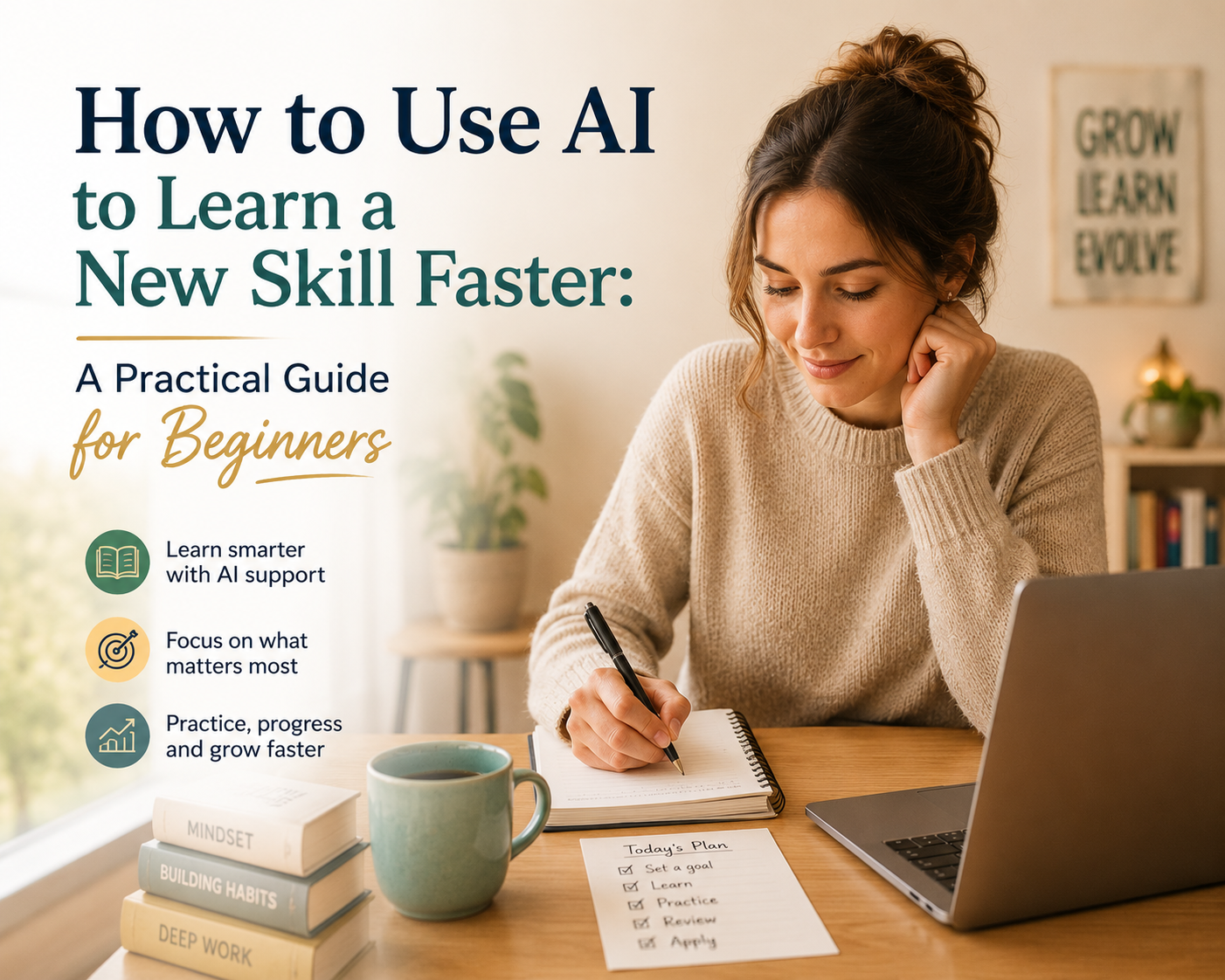
Most people who want to learn something new hit the same wall within two weeks. The YouTube tutorial moves too fast. The online course is either too basic or assumes knowledge you don’t have. The textbook is dry and impossible to apply. The person who could answer your specific question is either unavailable, too expensive to hire, or unlikely to spend forty minutes answering the exact follow-up question you need answered right now. Learning how to use AI to learn a new skill addresses every one of these problems simultaneously — and the results, when done correctly, are genuinely faster and more effective than most traditional self-study approaches. This guide covers exactly how to do it.
Why Traditional Self-Learning Is So Frustratingly Slow
Before covering the AI approach, it is worth being specific about why learning a new skill on your own is so often slower than it should be. The core problem is a mismatch between the pace and level of available resources and the pace and level you actually need.
Generic tutorials are designed for a hypothetical average learner. They move too fast through things you need more time on, and spend too long on things you already understand. They cannot respond to your specific confusion, because they were recorded before you had it. Plus, they cannot give you a different explanation when the first one doesn’t land, because they don’t know the first one didn’t land.
Furthermore, the moment you get stuck — genuinely stuck, in a way that needs a specific answer to a specific question — traditional resources leave you searching through forums, rewatching video segments, and hoping someone else had exactly the same confusion. That process can consume hours for a question that should take minutes to resolve.
AI changes this entirely by being infinitely patient, infinitely available, and capable of adapting its explanation to exactly your current level and your specific question.
How to Use AI to Learn a New Skill: Setting Up the Right Learning Relationship
The first step in using AI to learn a new skill is establishing the right kind of learning relationship at the start of the conversation. This means telling the AI your current level, what you want to achieve, and how you want it to interact with you.
A strong opening prompt for any learning goal looks like this: “I want to learn [skill]. My current level is [beginner / some basic knowledge / intermediate]. My goal is to [describe what you want to be able to do — not just ‘learn it’ but the specific outcome you’re working towards]. I want you to act as my personal tutor for this skill. Please start by giving me a clear learning roadmap — the key stages I’ll go through, in the right order, with an honest estimate of how long each stage takes. Then ask me which stage I’m ready to start with.”
This prompt does several important things simultaneously. It establishes you as a specific learner with a specific goal rather than a generic user. It asks for a roadmap, which gives you the big-picture orientation that self-learners consistently lack. And it positions the AI as a tutor rather than an information source — a relationship that produces better learning outcomes throughout the conversation.
How AI Explains Things Differently From Any Other Resource
The single most powerful capability AI offers for learning a new skill is its ability to re-explain the same concept in a completely different way the moment you tell it the first explanation didn’t work for you.
Every learner has a different mental model, different prior knowledge, and different ways that new information clicks into place. A textbook has one explanation. A tutor who understands their craft has ten. AI effectively has unlimited explanations and can generate a new one tailored to your specific point of confusion instantly.
When an explanation doesn’t land, don’t move on. Instead, tell the AI specifically what you didn’t understand: “I followed this part, but I lost you here — can you explain [specific concept] using a completely different approach? Maybe an analogy or a real-life example?” The new explanation will take a genuinely different angle — often one that connects the new concept to something you already know, which is consistently the fastest path to understanding.
This iterative explanation approach — keep asking for different angles until it clicks — is one of the primary ways AI accelerates skill learning compared to static resources.
Using AI to Create a Personalised Practice Plan
Understanding something conceptually and being able to do it are different things, and the gap between them is bridged by practice. One of the most underused capabilities of AI for learning new skills is its ability to generate customised practice exercises tailored exactly to your current level and your specific gaps.
Once you’ve understood a concept, ask your AI tutor to give you practice exercises: “I think I understand [concept]. Can you give me three practice exercises that test whether I’ve actually understood it, starting easy and getting harder? After I attempt each one, I want you to tell me if I’m right and explain where I went wrong if not.”
This creates an immediate feedback loop that traditional learning resources cannot provide. You practise, you get feedback, you correct your understanding, and you practise again. The AI adjusts the difficulty based on your performance, gives you more of what you need practice on, and moves you forward when you’re ready.
For skills that involve writing, analysis, or problem-solving — learning to write business proposals, understanding financial statements, learning a new language, developing marketing skills — this practice-and-feedback loop produces skill development that would previously have required a human tutor or coach.
How to Use AI to Learn a New Skill Without Getting Overwhelmed
One of the most common failure modes in learning a new skill is information overload — taking in more concepts than you can consolidate, losing track of where you are in the learning journey, and eventually giving up because it all feels like too much.
AI helps prevent this by keeping you focused on one concept at a time and explicitly telling you when to move on. A practical technique is to end each learning session by asking the AI to summarise what you covered, confirm what you now understand, and tell you exactly where to start in the next session.
“Before we finish, please summarise what I learned in this session in plain language. Tell me which concepts I seem to have understood well based on our conversation, which ones I should review again next time, and what the first thing we should cover in my next session should be.”
This session-ending summary creates a clear bridge between sessions that prevents the common experience of sitting down to study the following day and not knowing where you are or where to begin.
Specific Skills Where AI Learning Works Particularly Well
While AI is a useful learning partner for almost any skill, it works particularly well for specific categories where immediate, personalised feedback is most valuable.
Writing and communication skills. Share your writing with AI and ask for specific, actionable feedback — not just “this could be clearer” but “this sentence is confusing because of X, and here is how to fix it.” The ability to get detailed writing feedback on demand, without waiting for a teacher or editor, accelerates writing skill development significantly.
Financial literacy. Many adults feel embarrassed about gaps in their financial knowledge and reluctant to ask questions that might reveal those gaps. AI is a judgment-free zone. Ask every basic question you’ve been too embarrassed to ask elsewhere — how compound interest actually works, what a balance sheet is, what the difference between gross and net profit is — and get a patient, clear explanation every time.
Learning a new language. AI is an infinitely patient conversation partner, grammar explainer, and vocabulary teacher. It cannot replicate the immersion of speaking with a native speaker, but for grammar questions, vocabulary building, writing practice, and translation exercises, it is available at any hour and never makes you feel self-conscious about mistakes.
Understanding technology. For the target reader of this blog, this is particularly relevant. AI explains software, apps, digital tools, and technical concepts in whatever level of plain language you need. Instead of googling and reading through technical documentation, you can simply ask — “Explain how [technology] works as if I have never used it before” — and get an explanation calibrated to your level.
How to Use AI to Stay Motivated While Learning a New Skill
Motivation is the factor that learning guides rarely address honestly. Starting a new skill is exciting. The middle phase — when the initial enthusiasm has faded, progress feels slow, and you’re not yet good enough to feel the satisfaction of competence — is where most self-learners quit.
AI helps with motivation in a practical rather than an inspirational way. Ask it to help you track your progress: “Based on what I could do when we started and what I can do now, what progress have I made?” Seeing your progress articulated clearly provides genuine motivation to continue.
Ask it to help you through specific moments of frustration: “I’ve been trying to understand [concept] for an hour and I’m getting more confused, not less. Can you start from scratch with a completely fresh explanation, as if we’d never discussed this before?” Giving yourself permission to restart without judgment — and having an infinitely patient resource that never sighs or checks its watch — removes one of the most common emotional barriers to continued learning.
Finally, ask it to connect what you’re learning to your actual goal regularly: “Can you show me a real example of how [what I just learned] applies to [my specific goal]?” Keeping the learning connected to something that matters to you is the most reliable motivation available.
Common Mistakes When Using AI to Learn New Skills
Several common mistakes undermine the effectiveness of AI-assisted learning and are worth avoiding explicitly.
Treating AI as a search engine rather than a tutor is the most common. Asking a single question, reading the answer, and moving on produces surface-level familiarity rather than genuine understanding. The learning happens in the follow-up questions, the practice exercises, and the moments where you tell the AI the explanation didn’t work and ask for another.
Skipping practice is the second common mistake. Understanding an explanation is not the same as being able to do something. Every concept needs to be tested through practice before you move on, or the understanding remains fragile and quickly fades.
Moving on before a concept is solid is the third. The temptation to keep progressing — to cover more ground, to get to the interesting advanced material — consistently produces shakier learning than consolidating each stage before moving forward. Tell the AI when you’re not sure you’ve understood something, rather than hoping it will become clearer later.
For a broader picture of what AI tools can and cannot do across different contexts, our guide to AI capabilities and limitations is worth reading alongside this one.