Understanding your competitive landscape is one of the most important things a business owner can do. It is also one of the most consistently underdone, particularly in small businesses where time and budget for research are limited. Professional competitive analysis can cost thousands of pounds when commissioned from a consultant or agency. Learning how to use AI to research competitors brings a meaningful portion of that capability within reach of any business owner with a laptop and an afternoon. This guide covers the practical approach and the specific tools that work best. It also covers the limitations you need to understand to use AI-assisted competitive research reliably.
What AI Can and Cannot Do for Competitor Research
Before diving into the process, it is important to be clear about what AI-assisted competitive research is and isn’t. AI tools are excellent at synthesising publicly available information — websites, review platforms, social media, news articles, and industry directories — into structured, useful insights. They can help you understand how competitors position themselves, what customers say about them, how they price their products or services, and what marketing approaches they appear to be using.
What AI cannot do is access proprietary information — internal pricing data, financial performance beyond what’s publicly filed, private strategy documents, or non-public communications. AI-assisted competitive research is, at its core, a structured analysis of public information. For most small business purposes, this is entirely sufficient. It is also considerably more thorough than most business owners manage to do manually.
The Right Tools for Competitor Research
Different AI tools contribute different capabilities to competitor research, and the most effective approach uses them in combination.
Perplexity is the primary tool for initial research. Because it searches the web in real time and cites its sources, it is one of the most reliable options for gathering current, verifiable information about competitors. It surfaces recent news, current pricing, customer reviews, and market positioning. It does this from live web sources rather than from a fixed training dataset that may be months out of date.
Claude is the primary tool for analysis and synthesis. You gather raw information — from Perplexity, from your own browsing, or from industry sources. Once this is done, Claude turns that information into structured analysis, identifies patterns, and helps you draw strategic conclusions. Its ability to process large amounts of text and produce clear, organised output makes it well-suited to the analytical phase of competitor research.
ChatGPT may also serve a useful supplementary role here. It is useful for generating research frameworks, helping you structure your thinking, and producing formatted outputs like comparison tables or briefing documents.
Step 1: Identify Your Competitors
Start by using AI to make sure you have a complete picture of your competitive landscape. Many business owners have a clear view of their direct competitors — businesses offering the same product or service — but a less complete view of indirect competitors and adjacent alternatives.
Ask Perplexity: “What businesses compete with [describe your business and what it offers] in [your market or geography]? Please include direct competitors offering the same product or service and indirect competitors offering alternative solutions to the same customer problem.”
Review the results and add any competitors you know of that didn’t appear. You now have a working list to research systematically.
Step 2: Research Each Competitor’s Positioning
For each competitor, use Perplexity to gather a structured picture of how they present themselves. A practical prompt is: “Please research [competitor name] and tell me: what they sell, how they describe themselves and their main value proposition, who their apparent target customer is, what their pricing looks like if available, and what recent news or developments there are about them.”
Work through your competitor list systematically, gathering a consistent set of information for each one. Paste the results into a single document as you go — this becomes your raw research material for the analysis phase.
Step 3: Analyse Customer Sentiment
One of the most valuable sources of competitive intelligence is what customers say about your competitors publicly. You will see these in reviews, social media comments, and forum discussions. It tells you what competitors do well, where they fall short, and what unmet needs their customers have.
Ask Perplexity: “What do customers commonly say about [competitor name]? Please summarise the most common positive themes and the most common complaints or criticisms from public reviews and discussions.”
The resulting summary gives you a clear picture of each competitor’s strengths and weaknesses from the customer perspective. This is considerably more useful than what the competitor says about themselves. Patterns in what customers wish were better represent potential opportunities for your own positioning.
Step 4: Build a Competitive Analysis With Claude
With your raw research gathered, switch to Claude for the analytical phase. Paste in your research notes — positioning summaries, pricing information, customer sentiment — and ask for a structured competitive analysis.
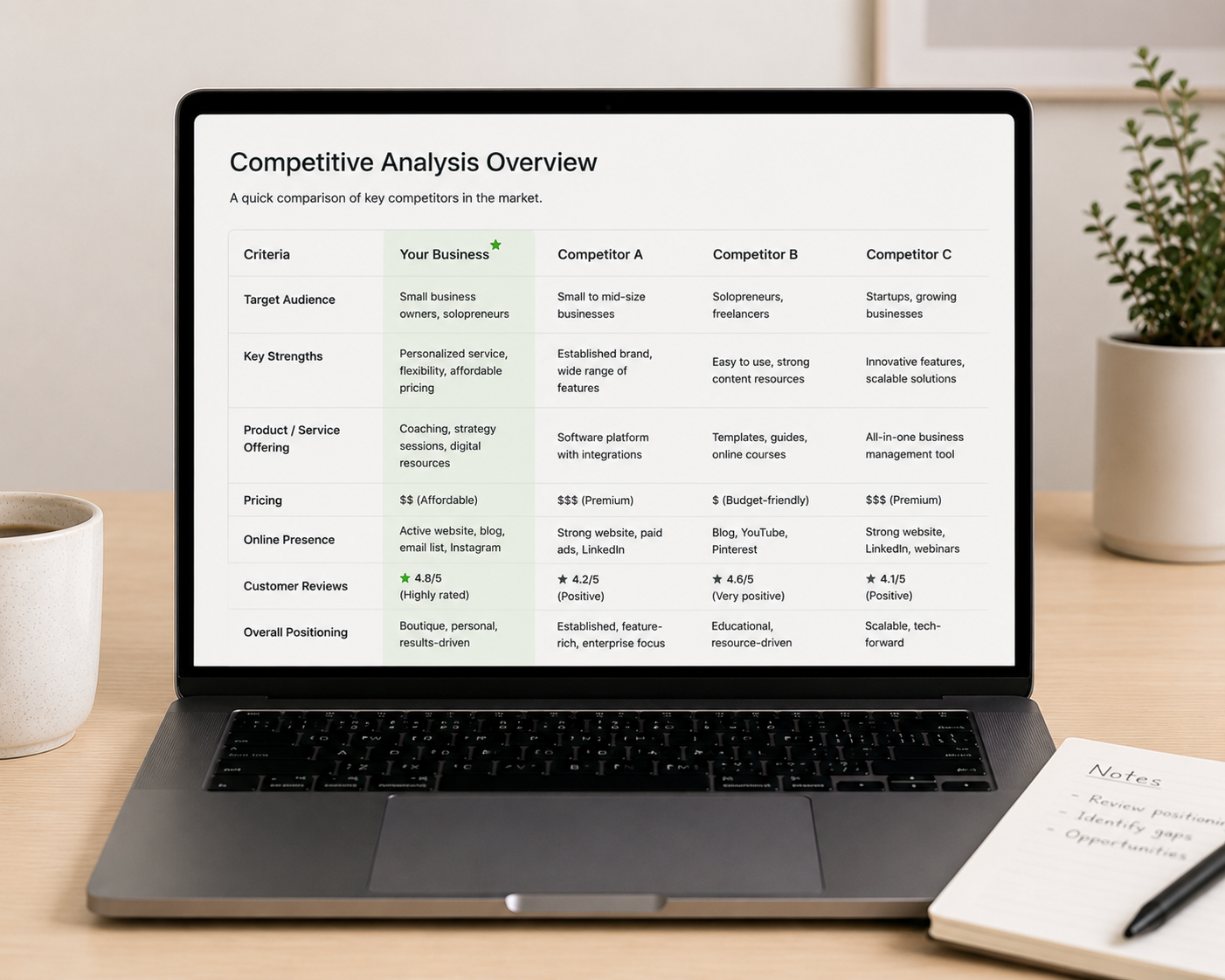
“Here is my research on my main competitors: [paste research]. Please analyse this and produce: a comparison table showing each competitor’s positioning, pricing, and apparent strengths and weaknesses; an identification of any gaps in the market that none of them appear to be addressing well; and two or three strategic implications for my business based on what you’ve found.”
The output gives you a structured, actionable competitive analysis in a format you can use immediately — for a strategy meeting, a marketing planning session, or simply as an informed basis for business decisions. This builds naturally on the marketing planning process covered in our marketing plan guide.
Step 5: Monitor Competitors Ongoing
Competitive research is not a one-time exercise. Markets change, competitors evolve, and new entrants emerge. Building a simple ongoing monitoring habit using AI keeps your competitive picture current without requiring dedicated research time.
Set a monthly reminder to spend thirty minutes running updated Perplexity searches on your key competitors. Get their recent news, new products or services, pricing changes, and customer feedback trends. Ask Claude to compare the new information against your existing analysis and flag anything significant. This monthly thirty-minute habit replaces the need for periodic comprehensive research. In addition, it keeps you better informed than most small business competitors, who don’t research at all.
For solopreneurs managing this alongside everything else, the workflow integrates naturally into the broader AI-assisted business operations described in our solopreneur tools guide and our small business AI guide.